
Getting paid for short-form content on YouTube isn't automatic, you have to hit specific thresholds first. The YouTube Shorts monetization requirements have evolved since the program launched, and heading into 2026, creators still need to clear defined subscriber and view milestones before they can earn a cent from ad revenue sharing or fan funding features.
If you're a founder, business owner, or creator using Shorts to build authority and drive inbound leads, understanding these requirements matters. Not because ad revenue alone will change your business, it probably won't, but because monetization eligibility signals credibility to your audience and unlocks tools that compound your content's impact over time. It's one piece of a larger growth system.
At SocialRevver, we build and operate short-form content engines for professionals who treat organic social as a revenue channel, not a hobby. Knowing where the monetization goalposts sit helps our clients plan smarter. Below, we break down every requirement you need to meet in 2026, including the lower-tier thresholds most guides skip, so you can map a clear path from zero to eligible, and beyond.
Why YouTube has Shorts monetization requirements
YouTube doesn't hand out monetization access freely, and that's by design. The YouTube Partner Program (YPP) exists to connect advertisers with creators who have demonstrated they can build and hold a real audience. Without minimum thresholds, advertisers would have no reliable signal that a channel carries genuine reach or credibility, and the program would fill with channels producing low-effort content at scale.
YouTube protects advertiser confidence with eligibility gates
Advertisers spend real money to place ads against YouTube content, and they expect brand-safe, audience-verified placements in return. When YouTube enforces subscriber and view minimums, it gives advertisers a basic signal that a channel has earned genuine attention, not inflated numbers from bots or inactive accounts. This is why YouTube audits channels for artificial engagement before approving monetization, and why the thresholds aren't just bureaucratic checkboxes. They're filters designed to keep the ad marketplace functional and worth participating in for both sides.
The requirements exist to protect the ecosystem, not to make your path harder. Meeting them means you've demonstrated something real to both YouTube and its advertisers.
Requirements filter for creators who publish consistently
Beyond protecting advertisers, the thresholds serve a second purpose: they filter for creators who post with enough regularity and quality to sustain an audience over time. A channel that uploads ten videos, goes quiet for six months, then applies for monetization hasn't demonstrated anything useful to YouTube or the brands buying ad space. The 90-day view window built into the Shorts requirement reflects this logic directly. YouTube wants to see recent, sustained activity, not a burst of uploads from a year ago that no longer represent your current output.
For you as a founder or creator, this framing matters. The YouTube Shorts monetization requirements aren't arbitrary gates you're waiting to pass. They're a proxy for whether your content system is actually working. If you're consistently hitting views within the rolling 90-day window, you're already doing the thing that monetization rewards. The eligibility follows from the behavior, not the other way around.
Understanding this helps you focus on the right inputs: regular publishing, strong hooks, and content that earns real watch time, rather than fixating on a number that won't hold without the underlying system behind it.
YouTube Shorts monetization eligibility for 2026
YouTube structures its partner program into two tiers, and the youtube shorts monetization requirements differ depending on which tier you're targeting. Knowing both thresholds helps you set a realistic timeline instead of aiming for a single milestone without context.
The standard YPP tier for ad revenue sharing
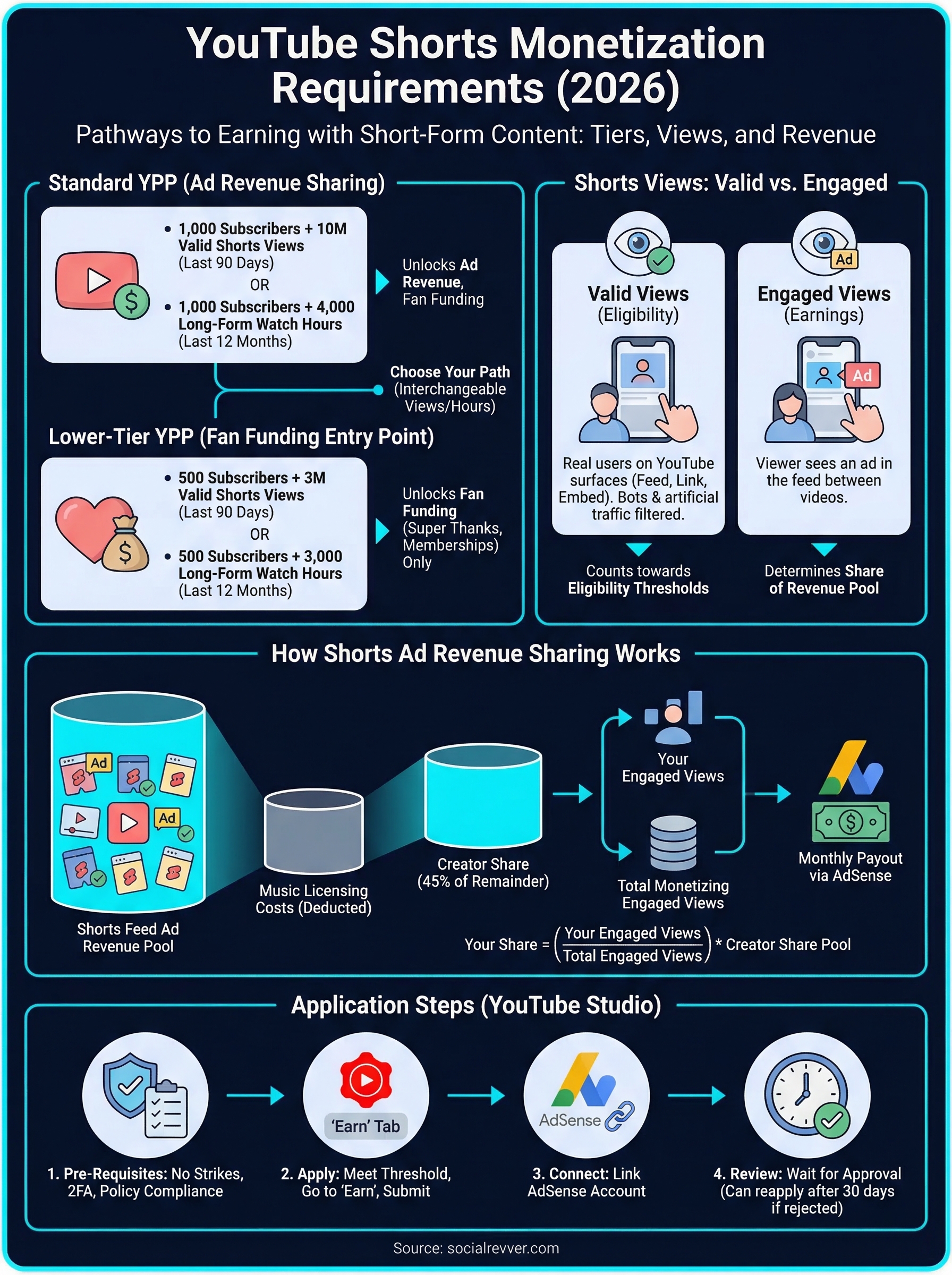
To qualify for the full YouTube Partner Program and unlock Shorts ad revenue sharing, you need to meet one of two content milestones alongside a subscriber floor. YouTube requires 1,000 subscribers plus either 10 million valid public Shorts views in the last 90 days, or 4,000 valid public watch hours from long-form content in the last 12 months. The Shorts view path and the long-form watch hour path are interchangeable, so you can qualify through either format or a combination of both.
Hitting 10 million Shorts views in 90 days sounds steep, but channels that publish consistently and nail their hooks regularly reach this window without treating it as a sprint.
The lower-tier YPP entry point for fan funding
YouTube also offers a reduced-threshold tier that gives you access to fan funding features like Super Thanks, channel memberships, and Super Chat, but not ad revenue sharing. This entry point requires 500 subscribers plus 3 million valid public Shorts views in the last 90 days, or 3,000 valid public watch hours from long-form content. It's a faster path to monetization tools, and for founders building authority, features like memberships can generate direct revenue well before you cross the full ad revenue threshold.
What counts as valid Shorts views and engaged views
Not every view on a Short moves you closer to meeting the youtube shorts monetization requirements. YouTube distinguishes between raw view counts and valid public views, and only the latter count toward your 90-day threshold. Understanding the difference keeps you from building a false picture of your progress.
What YouTube considers a valid Shorts view
A valid view is a view from a real, logged-in or non-logged-in user who watches your Short through standard YouTube surfaces, like the Shorts feed, a direct link, or an embedded player. YouTube's systems actively filter out views it identifies as coming from bots, artificial traffic sources, or repeated self-views from the same device or account in a short window. Those get stripped from your count before your totals are evaluated against the threshold.
YouTube publishes its policies on invalid traffic through its advertising support documentation, and the same logic that governs ad impressions applies here.
How engaged views factor into Shorts revenue calculations
Engaged views are a separate metric that affects how much you earn per view, not whether you qualify. When a viewer watches your Short and sees an ad in the feed between videos, YouTube records that as an engaged view. Your share of ad revenue from the Shorts pool is calculated based on your proportion of engaged views relative to other monetizing creators in a given period. A higher ratio of engaged views signals that your content is holding attention through the ad-supported feed, which directly influences your monthly payout from the program.
How Shorts ad revenue sharing works in 2026
Understanding how the payout model functions helps you set realistic income expectations before you clear the youtube shorts monetization requirements and enter the program. Shorts ad revenue doesn't work the same way long-form monetization does, and the difference matters when you're planning your content strategy.
How YouTube builds the Shorts revenue pool
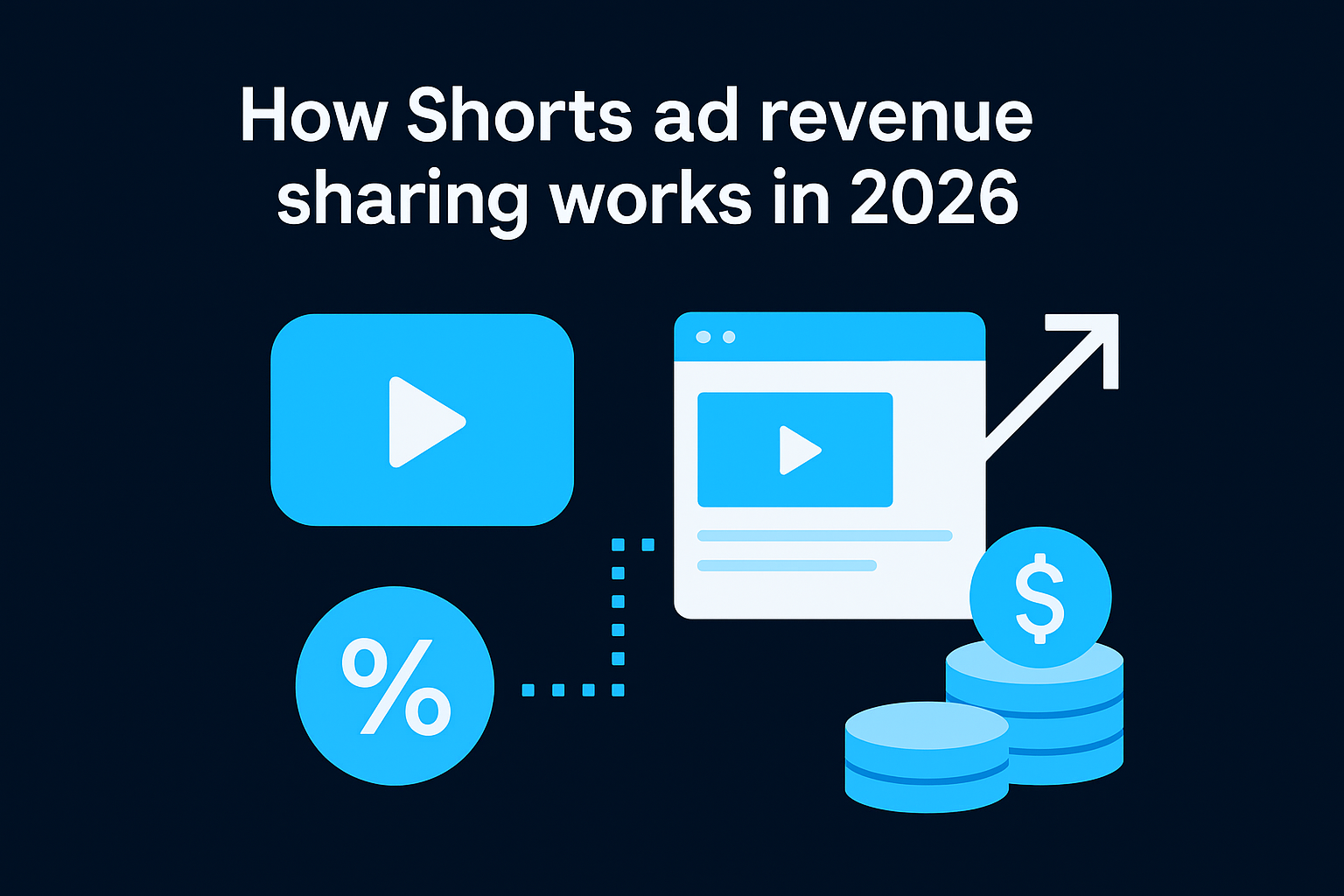
YouTube pools ad revenue generated between videos in the Shorts feed on a monthly basis. That pool comes from ads served to viewers as they scroll through Shorts, not from pre-roll or mid-roll ads attached to individual videos the way long-form content works. YouTube then takes its share of that pool to cover music licensing costs for any creator using licensed tracks, which is deducted before the creator payout is calculated.
This pooled model means your earnings aren't tied to a single video's ad performance but to your share of a much larger revenue bucket.
What percentage you take home
After YouTube removes the music licensing allocation, creators receive 45 percent of the remaining pool. Your individual share of that 45 percent depends on your proportion of total engaged views across all monetizing Shorts creators in that month. If your channel generates a larger slice of the engaged view total, you take a larger slice of the payout. YouTube pays this out through AdSense on the same monthly schedule as long-form revenue, so you'll see Shorts earnings consolidated in your existing AdSense account without needing a separate setup.
How to get monetized for Shorts step by step
Meeting the youtube shorts monetization requirements is straightforward once you know the exact sequence YouTube expects. The process runs entirely through YouTube Studio, and each step builds on the last, so there's no skipping ahead.
Set up your channel before you apply
Before you hit any threshold, make sure your channel has no active Community Guidelines strikes and that your content complies with YouTube's advertiser-friendly content policies. You also need two-factor authentication enabled on your Google account, which YouTube now requires as a baseline security check before processing any YPP application. Get these in order early so nothing blocks you when you cross the eligibility line.
Your channel also needs to follow YouTube's monetization policies, which cover content standards separate from Community Guidelines. Review your existing Shorts against these policies before applying, because a single non-compliant video can delay or block approval even if your channel statistics technically qualify.
Checking your channel's standing in YouTube Studio under the "Earn" tab gives you a real-time read on whether any violations could delay your application.
Apply and wait for review
Once your channel crosses either the 500-subscriber fan funding threshold or the full 1,000-subscriber ad revenue threshold, open YouTube Studio and click the "Earn" section in the left sidebar. YouTube will display your current eligibility status and prompt you to start the application when you qualify. Submit your application, agree to the YPP terms, and connect an AdSense account to receive payments. YouTube typically reviews applications within a few weeks. If your application is rejected, YouTube explains the specific reason and allows you to reapply after 30 days.
Wrap-up and next steps
The youtube shorts monetization requirements come down to two clear paths: hit 500 subscribers and 3 million Shorts views in 90 days for fan funding access, or reach 1,000 subscribers and 10 million Shorts views in the same window to unlock full ad revenue sharing. Neither threshold is arbitrary. Each one reflects whether your content system is generating real, sustained attention from actual viewers, not inflated counts that YouTube's systems will strip out anyway.
Meeting these requirements starts with publishing consistently and building content that earns genuine watch time, not fixating on a dashboard number. The metrics follow when the underlying system works.
If you want a data-driven content engine that builds toward monetization while generating authority and inbound leads for your business, apply to work with the SocialRevver team for a free 40+ slide strategy built around your niche, voice, and growth goals.