
Most creators treat hashtags like lottery tickets, throw a handful on every post and hope something hits. That approach stopped working a long time ago. A solid TikTok hashtag strategy is now one of the most misunderstood pieces of the short-form content puzzle, and getting it wrong means your best videos die in obscurity while mediocre content from competitors gets pushed to millions.
Here's the reality: TikTok's algorithm uses hashtags as a classification signal, not a discovery hack. The platform needs to understand what your video is about and who should see it. When you nail that classification, TikTok rewards you with reach. When you don't, your content gets served to the wrong audience, engagement tanks, and the algorithm buries it.
At SocialRevver, we've analyzed over 750,000 short-form videos through our Attention Engine to identify what actually moves the needle on reach and conversions. Hashtags are one piece of that system, a small but surprisingly impactful one when used with precision. The patterns we've found contradict most of the recycled advice floating around creator forums and outdated blog posts from 2022.
This guide breaks down the 3-3-3 hashtag rule, explains why it works in 2026, and gives you a repeatable framework you can apply to every video you publish. No guesswork, no hashtag generators, no copying what worked for someone else in a completely different niche. Just a data-backed approach to getting your content in front of the right people, consistently.
How TikTok hashtags work in 2026
TikTok's algorithm has matured significantly over the past few years. The platform no longer relies on hashtags as its primary discovery mechanism for surfacing content to new audiences. Instead, TikTok now processes multiple signals simultaneously, including video completion rate, sound identity, visual content recognition, captions, and hashtags, to build a complete picture of what your video is about and which users are most likely to engage with it. Hashtags are one input among many, and their role is more specific than most creators realize.
Hashtags as classification signals
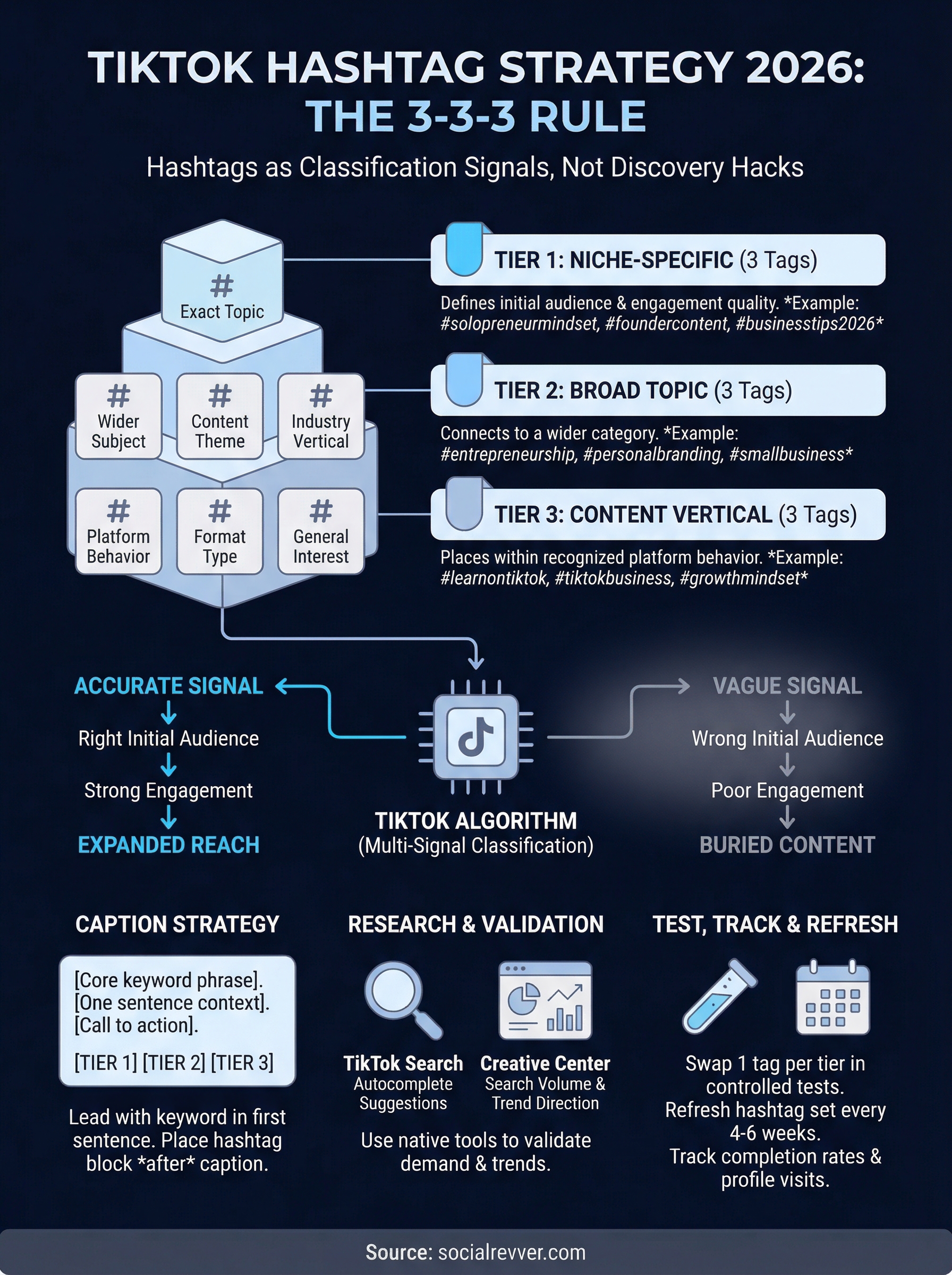
The most important shift in your TikTok hashtag strategy is recognizing that hashtags function as a classification signal, not a discovery lever. When you post a video, TikTok runs it through a content classification system that groups it alongside similar content and similar viewers. If your hashtags are vague, generic, or irrelevant to the actual video, the system struggles to place your content accurately, and your initial distribution push lands in the wrong viewer pool.
The algorithm uses your first audience interaction pool to decide whether to scale distribution further. If that pool is a poor match for your content, the signal dies there.
When TikTok misclassifies your video early, the platform shows your content to people who are unlikely to watch it in full or interact with it. Low completion rates and poor engagement in that first wave signal to the algorithm that the video is not worth promoting further. This is exactly why random hashtag stacking backfires: it dilutes the classification signal and damages your distribution potential before your video gets a fair audience.
How TikTok's recommendation system uses hashtag data
TikTok's recommendation engine works in layers of audience pools. Your video first reaches a small test group of roughly a few hundred viewers. If engagement signals from that group are strong, the platform expands distribution to a larger pool. Each promotion decision depends entirely on how well your content performed with the previous audience, not on how many hashtags you added.
Here is how hashtags fit into that layered process:
| Stage | What TikTok evaluates | How hashtags contribute |
|---|---|---|
| Initial pool | Content category match | Hashtags confirm what niche the video belongs to |
| First expansion | Engagement rate from pool 1 | Accurate hashtags attract the right viewers who engage |
| Broader push | Watch time and shares | Relevance established in earlier pools carries forward |
| Viral threshold | Social proof signals | Hashtags are no longer the primary driver at this stage |
Treating hashtags as early-stage targeting tools rather than viral growth levers changes how you build your entire content system. Their job is to place your video in front of the right first audience. Everything that follows that initial push depends on the quality of your content, not on the number of hashtags you stacked in the caption.
Build your core set with the 3-3-3 rule
The 3-3-3 rule gives your TikTok hashtag strategy a repeatable structure that replaces guesswork with deliberate targeting. Instead of stacking hashtags randomly, you build a nine-hashtag set divided into three distinct tiers, each serving a specific role in the classification process TikTok runs on your content.
The three tiers explained
Each tier targets a different layer of the algorithm's classification system. The first tier uses three niche-specific hashtags that describe your exact topic and audience. These are typically low-to-mid volume tags where your content competes in a defined space rather than getting buried under millions of posts. The second tier uses three broader topic hashtags that connect your content to a wider subject category. The third tier uses three high-level hashtags that place your video inside a recognized content vertical on the platform.
Niche-specific hashtags do the heaviest lifting in the 3-3-3 framework. They define your initial audience pool and set the engagement quality that drives every subsequent promotion decision.
How to apply the rule to a real post
Here is a template you can complete before every post. Replace the examples with tags specific to your niche and content type:
Tier 1 - Niche-specific (3 tags):
- Your specific subtopic (e.g., solopreneurmindset)
- Your audience descriptor (e.g., foundercontent)
- Your content format (e.g., businesstips2026)
Tier 2 - Topic category (3 tags):
- Broad subject (e.g., entrepreneurship)
- Content theme (e.g., personalbranding)
- Industry vertical (e.g., smallbusiness)
Tier 3 - Content vertical (3 tags):
- Platform behavior tag (e.g., learnontiktok)
- Format tag (e.g., tiktokbusiness)
- General interest (e.g., growthmindset)
Build this template once for your niche and adjust the niche-specific tier based on each individual video's topic. Your topic and vertical tiers should remain relatively stable across posts unless you shift content categories entirely.
Find hashtags using TikTok search and Creative Center
Guessing hashtags from memory is one of the fastest ways to waste your distribution potential. Your TikTok hashtag strategy needs to be built on real platform data, and TikTok gives you two free tools to do exactly that: the native search bar and the TikTok Creative Center. Both are underused by most creators, yet they show you exactly what the algorithm is currently indexing and promoting.
Use TikTok search to validate demand
Open TikTok and type a keyword that describes your video's topic into the search bar. Before you hit enter, scan the autocomplete suggestions that appear below. These suggestions reflect what real users are actively searching for right now, which means TikTok already associates those phrases with viewer intent. Each autocomplete suggestion is a potential hashtag candidate worth testing in your Tier 1 or Tier 2 slots.
The autocomplete list updates based on real search volume and trending behavior, making it one of the most current hashtag research signals available to you for free.
After you run the search, filter results by "Videos" and sort by "Most Liked." Look at the top-performing videos in your niche. Check which hashtags they use in their captions and note any patterns across multiple high-performing posts. You are looking for tags that appear repeatedly in content with strong engagement numbers, not just high view counts.
Pull data from TikTok Creative Center
The TikTok Creative Center gives you a dedicated hashtag analytics view with search volume data, trend direction, and related tags you can filter by industry and region. Navigate to the Trends section, select Hashtags, and set your region to the United States. Enter a broad topic term and review the related hashtag suggestions it surfaces.
Use this table to organize what you find before building your 3-3-3 set:
| Hashtag | Volume level | Trend direction | Assigned tier |
|---|---|---|---|
| Your niche subtopic | Low-mid | Rising | Tier 1 |
| Broad topic keyword | Mid | Stable | Tier 2 |
| Platform vertical | High | Stable | Tier 3 |
Fill this table with five to seven candidates per tier, then select the three strongest for each. Refresh your candidates every four to six weeks to stay current with shifting search behavior on the platform.
Write captions that index and convert
Your caption is more than a place to drop hashtags. TikTok's algorithm reads the full caption text as part of its classification process, which means every word you write either strengthens or weakens the signal your hashtags are already sending. A strong caption reinforces your topic, keeps viewers reading, and drives the comments and clicks that push your video into the next distribution tier.
Lead with your keyword, follow with context
The first sentence does the most indexing work. Write it to include the core keyword that describes your video's topic, using phrasing a real viewer would actually search for. Avoid vague openers like "watch this" or "you won't believe" because they give TikTok no useful classification data and they fail to hold attention from viewers who are already scrolling past.
The first line of your caption is visible before the "more" tap, so it needs to hook the viewer and signal the topic at the same time.
Use this template as your starting point for each post:
[Core keyword phrase that states what the video is about].
[One sentence that adds context or creates curiosity].
[A direct question or call to action for comments].

[Tier 1 tag] [Tier 1 tag] [Tier 1 tag]
[Tier 2 tag] [Tier 2 tag] [Tier 2 tag]
[Tier 3 tag] [Tier 3 tag] [Tier 3 tag]
Place hashtags at the end, not in the text
Embedding hashtags inside your sentence structure breaks the reading flow and signals low production quality to viewers. Your tiktok hashtag strategy performs best when the tags appear as a clean block below your caption text, keeping the copy readable while still delivering the full classification signal to the algorithm. Group your nine tags in three rows of three to match your tiers, which also makes it faster to swap individual tags when you run tests on new combinations.
Test, track, and refresh your hashtag system
Your TikTok hashtag strategy is not a set-it-and-forget-it system. Hashtag performance shifts as platform trends evolve, new creators enter your niche, and TikTok updates its classification behavior. Treating your hashtag set as a living document you test and update regularly is what separates creators who sustain consistent reach from those who see one good week and then stall.
Track which tier drives results
Run a controlled test every two weeks by swapping one tag in a single tier while keeping the other two tiers identical across posts. After five to seven posts with the new combination, compare your average watch time and profile visit rate against the previous set. You are not looking for viral outliers, you are looking for consistent engagement improvements across multiple videos.
A single viral post does not confirm your hashtags are working. A pattern of stronger early engagement across multiple posts does.
Use this tracking table to log your tests and spot which tier produces the most reliable signal:
| Test period | Tier changed | Tags swapped | Avg. completion rate | Profile visits | Keep or replace |
|---|---|---|---|---|---|
| Week 1-2 | Tier 1 | Old tag vs. new tag | Record % | Record count | Decision |
| Week 3-4 | Tier 2 | Old tag vs. new tag | Record % | Record count | Decision |
| Week 5-6 | Tier 3 | Old tag vs. new tag | Record % | Record count | Decision |
Refresh on a schedule
Every four to six weeks, run a fresh search in TikTok's Creative Center to check whether your current tags are still trending upward or losing momentum. Replace any tag showing a declining trend line with a rising candidate from your research list. This refresh cycle keeps your classification signal current without requiring a complete rebuild of your hashtag system each month.
Pull your candidate list from your earlier research table and rotate in the next strongest option. Your Tier 1 niche-specific tags will need the most frequent updates since niche conversations shift faster than broad platform verticals do.
Final checklist for your next post
Before you hit publish, run through this checklist to confirm your TikTok hashtag strategy is fully dialed in. Each item takes less than 60 seconds to verify and prevents the classification errors that kill distribution before your video gets a fair shot.
- Tier 1 tags match the specific subtopic of this exact video
- Tier 2 tags connect to the broader subject category
- Tier 3 tags place the content inside a recognized platform vertical
- Caption opens with your core keyword in the first sentence
- Hashtags appear as a clean block after the caption text, not embedded inside sentences
- All nine tags were validated in Creative Center within the last four to six weeks
- You have a tracking row ready to log this post's completion rate and profile visits
Consistency with this system is what builds compounding reach over time. If you want a team that handles hashtag research, scripting, production, and distribution for you, apply for a free social media strategy and see exactly how SocialRevver builds this engine for your brand.