Most startups burn through their first influencer marketing for startups budget with nothing to show for it. They pick creators based on follower counts, send free product, cross their fingers, and wonder why the needle didn't move. The problem isn't influencer marketing itself, it's the lack of a system behind it.
When done right, influencer partnerships give startups something paid ads can't: borrowed trust at scale. A single creator endorsement can shortcut months of brand-building, drive qualified leads, and establish category authority almost overnight. But "done right" requires more than a DM and a discount code. It requires strategy, structure, and a content engine that captures the attention influencers generate and turns it into measurable revenue.
That's the gap we see constantly at SocialRevver. Founders invest in influencer campaigns but have no infrastructure to capitalize on the momentum, no optimized content system, no conversion funnel, no feedback loop. The attention spikes, then flatlines. Our work building data-driven short-form content systems for founders and business owners has shown us exactly where influencer marketing fits inside a broader growth architecture, and where most startups leave money on the table.
This playbook breaks down how to plan, execute, and measure influencer marketing on a startup budget. You'll get a step-by-step framework for finding the right creators, structuring deals that protect your cash flow, producing content that compounds, and tracking ROI with precision, not guesswork.
What influencer marketing looks like for startups
When a Fortune 500 company runs an influencer campaign, they have a dedicated team, a six-figure budget, and legal counsel reviewing every contract. When you do it as a startup, the reality is leaner, faster, and more personal. Influencer marketing for startups sits at the intersection of trust-building and direct response, meaning you need campaigns that do more than just get eyes on your brand. You need creators whose audiences are already primed to buy what you're selling, not just scroll past your product.
How startup influencer campaigns differ from big-brand ones
Big brands use influencers to reinforce awareness they've already built over years. You're using influencers to build awareness from scratch, which completely changes how you should structure deals, measure success, and choose creators. Where a major consumer brand might run a three-month campaign with 50 macro-influencers to shift brand sentiment metrics, a startup needs tightly scoped, conversion-oriented activations with 3 to 10 creators who have real pull over a specific audience segment.
The most significant difference is leverage. Big brands pay upfront because they have the cash, and influencers often discount rates to carry recognizable names in their portfolio. You don't have that brand equity yet, but you have something else: a genuine story. Startups typically carry a founder narrative, a specific problem worth solving, and a product that feels newer and more interesting than what established brands push. Lean into that narrative because it's what makes a creator's audience actually pay attention instead of tuning out.
The creator's credibility is only valuable to you if their audience overlaps with your actual buyer. Reach without relevance is just expensive noise.
The three campaign models startups use
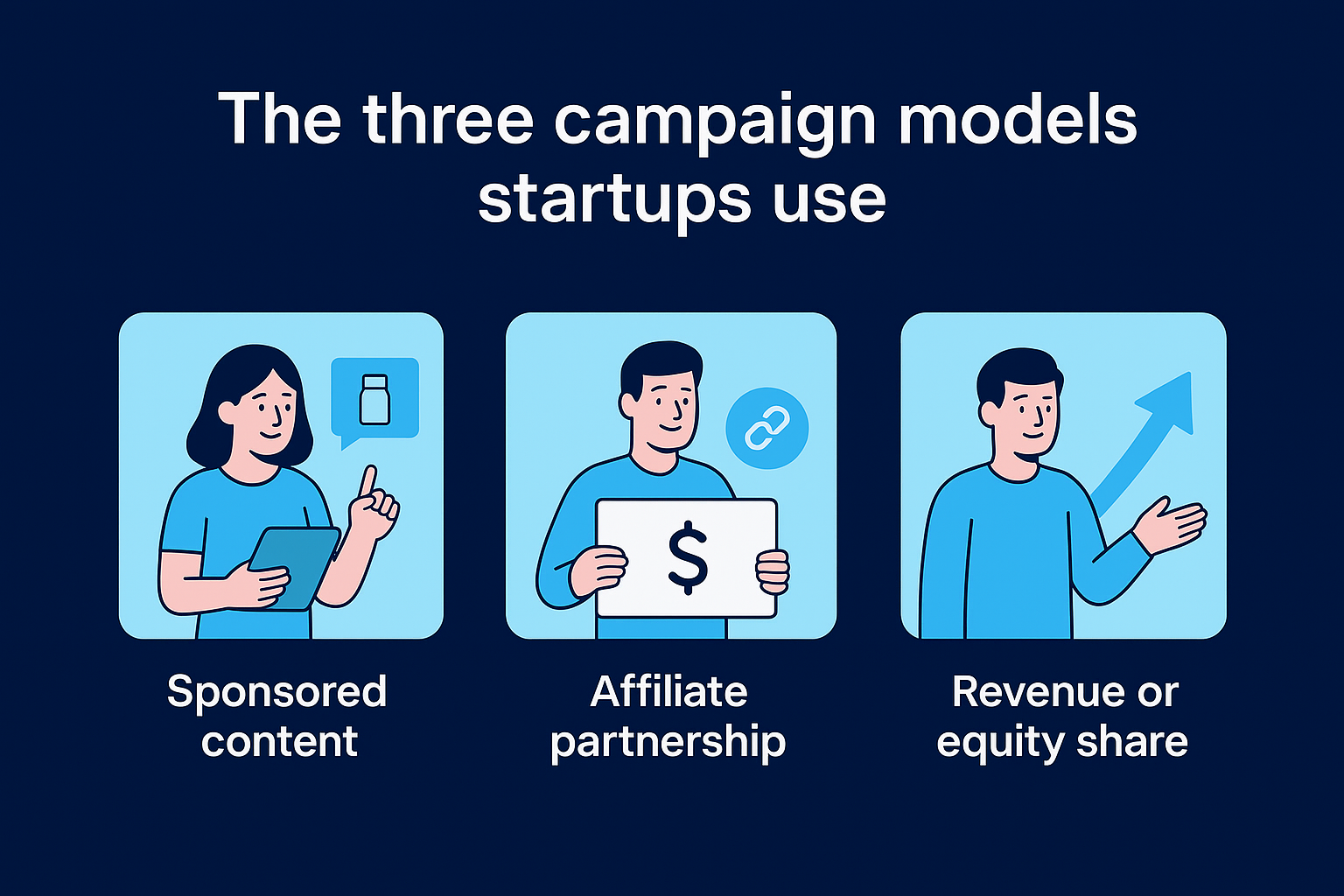
Before you contact a single creator, decide which campaign model fits your current stage, budget, and goal. Most startups default to one-off sponsored posts because they feel simple, but that's rarely the highest-ROI structure available to you. Three models consistently produce results at the startup level:
| Model | How it works | Best for |
|---|---|---|
| Sponsored content | You pay a creator a flat fee to feature your product in one or more posts | Fast awareness, new product launches, audience validation |
| Affiliate partnership | Creator earns a commission per sale using a tracked link or promo code | Cash-constrained startups that need performance proof before scaling spend |
| Revenue or equity share | Creator receives an ongoing percentage of revenue or a small stake in exchange for sustained promotion | High-conviction bets on rising niche creators aligned with your brand long-term |
Each model carries a different risk profile you need to understand before signing anything. Sponsored content carries upfront cost with no performance guarantee, which means you're paying for exposure, not results. Affiliate partnerships shift the financial risk to performance, which protects your budget but requires finding creators confident enough in your product's conversion rate to back it with their own reputation. Revenue share deals take more negotiation time but can generate compounding value if the creator's audience grows in parallel with your brand.
Your startup stage also determines which model makes sense. If you're pre-product-market fit, affiliate deals protect your cash while giving you real conversion data. If you've validated demand and need volume fast, sponsored content from several mid-tier creators in quick succession will move the needle faster than a single high-cost partnership. Matching the model to your stage prevents you from wasting budget on a structure your business isn't ready to support.
Set goals, budget, and guardrails
Running an influencer campaign without a defined goal is the fastest way to waste your budget. Influencer marketing for startups only produces measurable returns when you know exactly what you're trying to move, whether that's traffic, trial signups, or direct sales. Before you open a spreadsheet or contact a single creator, write down one primary goal and two supporting metrics. That constraint forces every decision that follows to serve a real business outcome.
Define your campaign goal first
Your goal determines everything: which creators you approach, what deliverables you request, and how you measure success. Three goals work well at the startup stage better than anything else: driving signups or trials, generating sales with a trackable promo code, or building social proof through video content you can repurpose. Pick one per campaign and resist stacking multiple objectives onto a single activation.
If you can't connect your campaign goal directly to a business metric, the goal isn't specific enough yet.
For example, if your goal is trial signups, your success metric is cost per signup, and you'll need a unique landing page URL per creator. If your goal is direct sales, your metric is cost per acquisition, tracked through a custom discount code. Write both down before you brief anyone.
Set a realistic budget
Most early-stage startups should allocate between $2,000 and $10,000 for an initial influencer campaign, enough to test two to five creators at the micro or nano tier without overcommitting. Use this split as a starting framework:
| Budget line | Allocation |
|---|---|
| Creator fees | 60-70% |
| Production support (if needed) | 10-15% |
| Paid amplification of top posts | 15-20% |
| Contingency | 5-10% |
Paid amplification is the line most startups cut first and regret most. Boosting a creator's post that's already performing organically extends its reach at a fraction of the cost of a new placement.
Build in guardrails
Guardrails protect your brand and your cash before a deal goes sideways. Always set a content approval window of 48 to 72 hours before any post goes live, and specify the number of revision rounds allowed in writing, not in a DM thread.
Standard guardrails to include in every agreement:
- No competitor mentions or product comparisons
- No unverified claims about results or statistics
- No off-brand visuals, fonts, or color schemes
- Disclosure language must follow FTC guidelines
- Both parties retain clearly defined content usage rights
Choose the right influencer tier and platform
Picking the wrong tier is one of the most common budget mistakes in influencer marketing for startups. Follower count does not equal influence, and audience relevance beats raw reach every time. Before you build a shortlist, you need a clear framework for which creator size actually fits your goals and budget.
Understand the influencer tiers
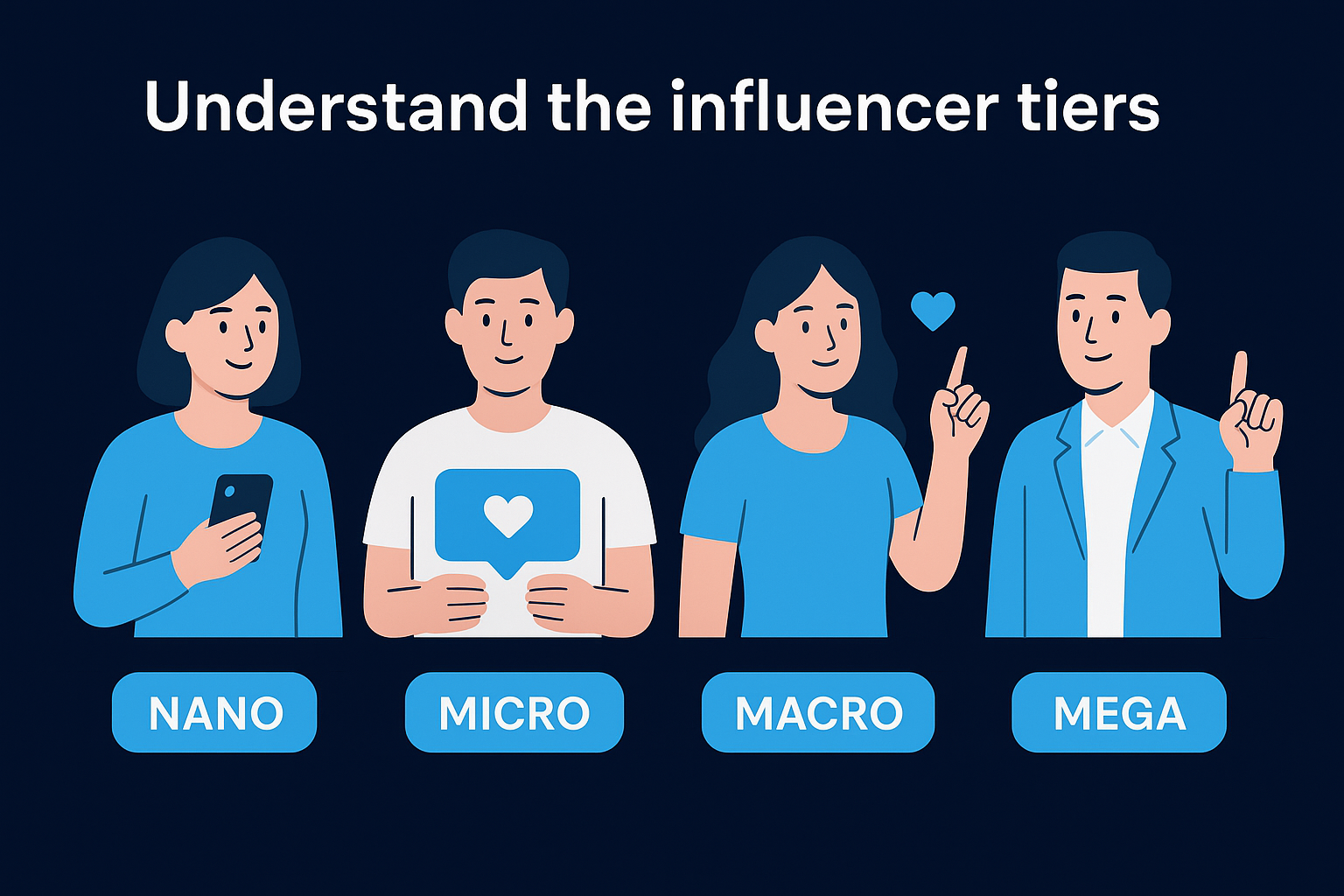
Four tiers define the influencer landscape, and each carries a different cost, engagement rate, and audience relationship. Nano and micro creators typically deliver the highest engagement per follower because their audiences know and trust them on a personal level.
| Tier | Follower range | Avg. engagement rate | Typical cost per post |
|---|---|---|---|
| Nano | 1K - 10K | 5-8% | $50 - $300 |
| Micro | 10K - 100K | 3-6% | $300 - $2,000 |
| Macro | 100K - 1M | 1-3% | $2,000 - $15,000 |
| Mega | 1M+ | 0.5-1.5% | $15,000+ |
For most startups operating under a $10,000 campaign budget, micro-influencers are the default starting point. You get credible, niche audiences with conversion rates that often outperform macro-level placements at a fraction of the cost.
Match the platform to your product
Platform choice depends on two variables: where your buyer already spends attention and what content format best demonstrates your product. A B2C product with strong visual appeal belongs on TikTok or Instagram Reels. A B2B SaaS tool with a complex value proposition performs better on LinkedIn or YouTube, where long-form demonstrations can walk a viewer through actual results.
Use this quick matching guide before committing your budget to any single platform:
- TikTok: High-volume discovery, short buying cycles, consumer products under $100
- Instagram Reels: Visual products, lifestyle brands, audiences aged 25-40
- YouTube: Software, services, and products that benefit from demos or tutorials
- LinkedIn: B2B tools, professional services, and founder-brand building
Spreading one campaign across three platforms dilutes both your message and your attribution data. Start with one platform, prove the model, then expand.
Your goal at this stage is not to find the most popular platform. Pick the one where your buyer already has buying intent and let that single decision drive every other choice that follows.
Build a shortlist and spot fake influence
Building a shortlist is where influencer marketing for startups either gains traction or falls apart. Most founders skip the research phase and jump straight to outreach, which means they end up pitching creators whose audiences have no real overlap with their actual buyer. A structured shortlisting process saves money, protects your brand, and gives you a vetted pool of creators to draw from across multiple campaigns.
How to build your shortlist
Start by searching your own platform first. Look at who already mentions brands in your category and note which creators consistently show up in your competitors' comment sections or tag similar products. Use the platform's native search to filter by niche keywords, then cross-reference each creator against your buyer persona before adding them to a working spreadsheet.
Track these five data points for every creator you evaluate:
| Data point | Why it matters |
|---|---|
| Niche alignment | Their content category must match your buyer's interest |
| Audience location | Verify the majority of followers are in your target market |
| Engagement rate | Target 3%+ for micro-tier creators |
| Content quality | Production value should reflect your brand's positioning |
| Post frequency | Active creators post at least two to three times per week |
Aim to build a shortlist of 15 to 20 candidates so you have enough depth to absorb non-responses and eliminations before you start outreach.
A shortlist of 20 vetted creators gives you the flexibility to move fast without scrambling when your top choices don't respond.
Red flags that signal fake influence
Fake followers and inflated engagement are more common than most startup founders expect, and they're expensive to discover after a deal is signed. Before you finalize any creator, run their profile through a basic audit using the platform's native analytics tools.
Watch for these specific warning signs:
- Follower-to-engagement mismatch: 50K followers with fewer than 100 likes per post signals purchased followers
- Generic comment patterns: Repetitive comments like "great post" or single emoji responses at scale indicate bot activity
- Sudden follower spikes: A sharp jump followed by a flatline suggests a paid growth burst, not organic momentum
- Inconsistent audience demographics: If the creator's audience skews heavily toward accounts from unrelated regions, that audience is likely bought
Pitch, negotiate, and lock in deliverables
Most creators receive generic "collab?" messages every day. Your pitch needs to cut through that noise immediately by showing you've actually studied their content and can explain why your product fits their specific audience. A strong pitch takes three minutes to read and gives the creator everything they need to say yes without going back and forth five times.
Write a pitch that gets a response
Your outreach message should be short, specific, and tied to a concrete example from their content. Reference a recent video or post that drove you to reach out, name what you want, and state what you're offering. Skip the compliments and get to the point.
Use this pitch template as your starting structure:
Subject: [Product name] + [Creator name] - Quick collaboration idea

Hi [Name],

I watched your recent video on [specific topic] and noticed your audience
asks a lot about [pain point your product solves]. I'm the founder of
[Product name], and we help [target audience] do [core outcome].

I'd like to offer you [flat fee / affiliate deal] for [specific deliverable:
one 60-second Reel, one product integration in an existing video, etc.].

Here's a quick overview: [link to product page or one-pager]

Interested? Happy to send full details.

[Your name]
Keep the pitch under 150 words. Anything longer signals you haven't respected their time.
Negotiate rates without burning the relationship
Rates are almost always negotiable, especially with micro and nano creators who are still building their brand partnerships portfolio. When a creator quotes above your budget, don't reject outright. Counter with a performance-based structure by offering a lower upfront fee plus an affiliate commission tied to actual sales.
Two negotiation levers that protect your budget without damaging the relationship:
- Deliverable scope: Reduce from two posts to one, or shift from a dedicated video to a product integration inside existing content
- Usage rights trade-off: Offer a higher fee in exchange for the right to run the creator's content as a paid ad, which gives you long-term value from a single activation
Lock in deliverables in writing
Once you've agreed on terms, document every detail in a short written agreement before any content goes live. This protects both parties and prevents scope creep. Your agreement should specify the exact deliverables, go-live dates, revision limits, payment terms, and FTC disclosure requirements. Even for influencer marketing for startups at the nano tier, a written summary prevents disputes that waste more time than the campaign itself is worth.
Write a brief creators can actually follow
A weak brief is the most preventable cause of off-brand content in influencer marketing for startups. When creators receive a wall of requirements, a vague mood board, or a two-page legal document instead of a usable guide, they default to their own interpretation, which may have nothing to do with your buyer's actual pain points. A good brief takes 30 minutes to write and saves three rounds of revisions.
A brief is not a script. It gives the creator the context they need to produce content that converts without stripping the authenticity that makes their audience trust them.
Cover the six essentials
Your brief should be one to two pages maximum and structured so a creator can skim it in under five minutes and know exactly what you need. Leave out anything that doesn't directly affect the content they're producing.
Include these six elements in every brief you send:
- Brand context: One short paragraph on what your product does, who it's for, and the one outcome it delivers
- Campaign goal: State the single metric you're optimizing for, such as trial signups or promo code redemptions
- Key message: One sentence the creator must communicate, not five talking points
- Mandatory inclusions: Specific items the post must contain, such as your product name, a CTA, a unique link, or FTC disclosure language
- Hard restrictions: What the creator must not say or show, such as competitor comparisons or unverified claims
- Deliverable specs: Format, length, platform, posting date, and number of revision rounds allowed
Give creative direction without micromanaging
The brief should guide the tone and message direction, not dictate every word. Creators who feel overly controlled produce stiff content that their audiences can immediately identify as paid promotion. Instead of writing a script, describe the emotional outcome you want the viewer to feel and give one or two examples of content styles that match your brand.
Use this format for the creative direction section of your brief:
Tone: Conversational, direct, no hard sell
Viewer should feel: [e.g., "This solves a problem I actually have"]
Example content style: [link to a creator's post that matches the energy you want]
What to avoid: Corporate language, feature lists, staged reactions
Providing a reference example removes ambiguity faster than any written description can.
Launch the campaign and manage day to day
Going live is not a finish line, it's the start of the most operationally demanding phase of your campaign. In influencer marketing for startups, the difference between a campaign that compounds and one that flatlines often comes down to how closely you manage the 72 hours after the first post goes live. Set up your tracking links, confirm every creator has the correct CTA, and verify that your landing page or promo code is live and functional before any content publishes.
Coordinate the launch window
Timing creator posts within a narrow launch window amplifies the social signal and drives platform algorithms to surface the content to a wider audience. When three creators post about your product within 48 hours of each other, the compounding visibility effect is significantly stronger than spreading posts across two weeks.
Use this pre-launch checklist before any creator posts:
- Confirm the unique tracking link or promo code is active and tested
- Verify the landing page loads correctly on mobile
- Check that the creator has the final approved content version, not a draft
- Confirm the post date and time in writing with each creator
- Set calendar reminders to check live posts within one hour of the scheduled time
Monitor performance in real time
Once content goes live, check performance every 24 hours for the first three days. You are looking for early signals: click-through rate on the tracking link, promo code redemptions, and comment sentiment. These early indicators tell you whether to amplify the post with a paid boost or whether you need to adjust your CTA or landing page.
If a creator's post generates strong organic engagement in the first 12 hours, that is the moment to put $200 to $500 in paid amplification behind it. Waiting 48 hours cuts the return significantly.
Keep a shared log of all campaign activity including post URLs, live dates, early engagement numbers, and any creator questions or issues. This log serves two purposes: it gives you a clean record if a dispute arises, and it becomes your reference document when you brief the next round of creators on what worked and what to change.
Measure ROI with clean attribution
Most influencer marketing for startups campaigns fail the measurement test not because results were poor, but because the tracking setup was too loose to read them clearly. If you rely on a single promo code shared across three creators and a Google Analytics dashboard you check once a week, you will never know which creator drove which result. Clean attribution starts before the campaign launches, not after you're trying to explain the numbers to your co-founder.
Set up your tracking before launch
Every creator in your campaign needs their own unique tracking link and, if you're running a promo code, a code that belongs exclusively to them. Use UTM parameters to tag each link with the creator's name, the platform, and the campaign name. This gives you source-level data in your analytics platform without any guesswork.
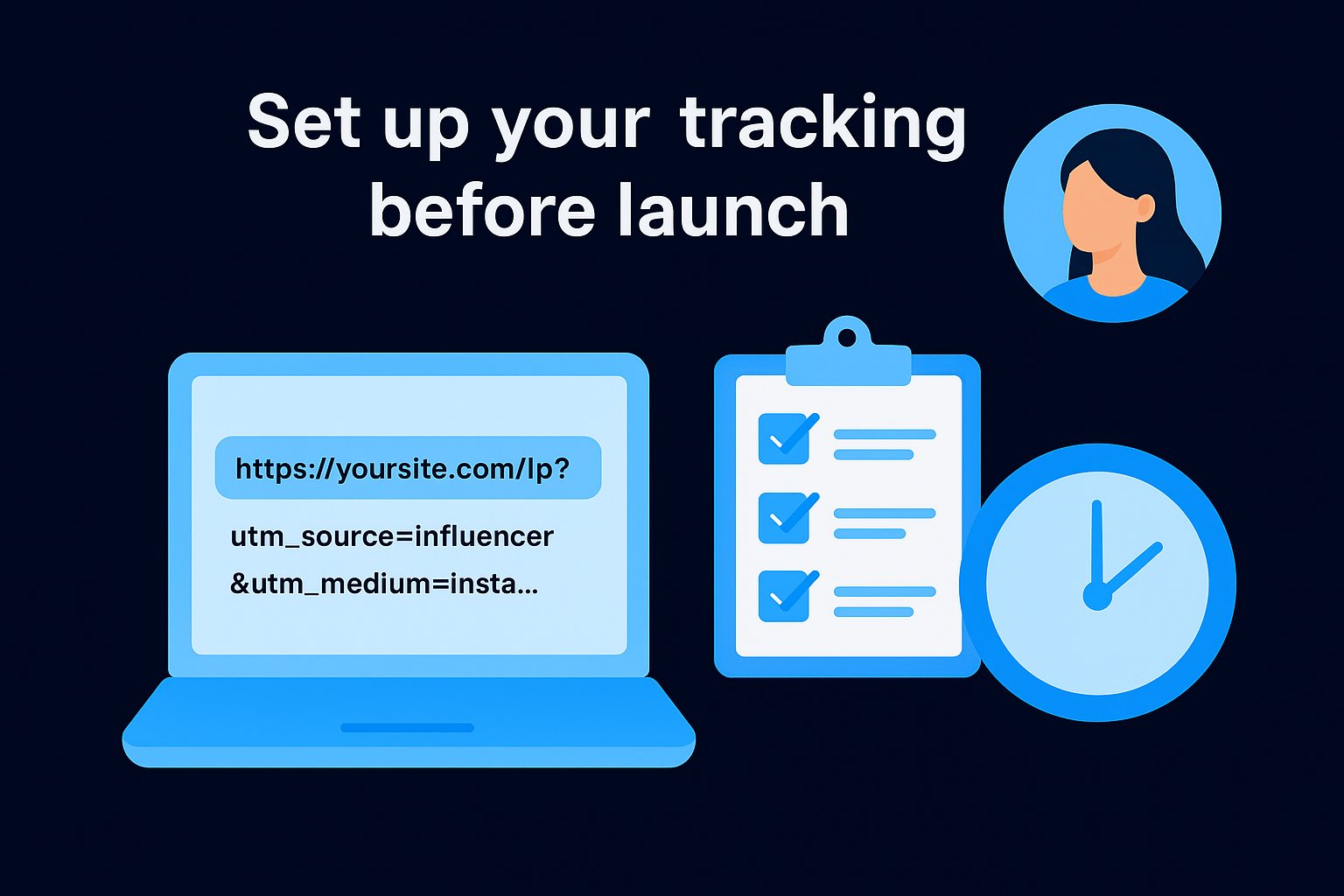
Use this UTM structure for every creator link you generate:
https://yoursite.com/lp?utm_source=influencer&utm_medium=instagram
&utm_campaign=spring2026&utm_content=creatorname
Track these five metrics from day one of the campaign:
- Clicks per creator link: Raw traffic each creator sends to your landing page
- Conversion rate per creator: Percentage of clicks that complete your goal action
- Promo code redemptions: Direct sales tied to each creator's unique code
- Cost per acquisition (CPA): Total creator fee divided by conversions generated
- Return on ad spend (ROAS): Revenue generated divided by total spend, expressed as a multiplier
Calculate your actual return
Once the campaign window closes, pull your data into a simple attribution table that puts every creator side by side. This comparison tells you exactly which tier, platform, and content style produced the lowest CPA and the highest ROAS, which becomes your brief for the next campaign.
A creator with half the followers of another but double the conversion rate is always the better investment. The numbers make that visible only if your tracking was clean from the start.
Your ROI calculation is straightforward: subtract total campaign spend from total revenue attributed to the campaign, then divide by total spend and multiply by 100. A result above zero means the campaign paid for itself. Anything above 200% means you have a model worth scaling with the same creator profile and brief structure.
Next steps
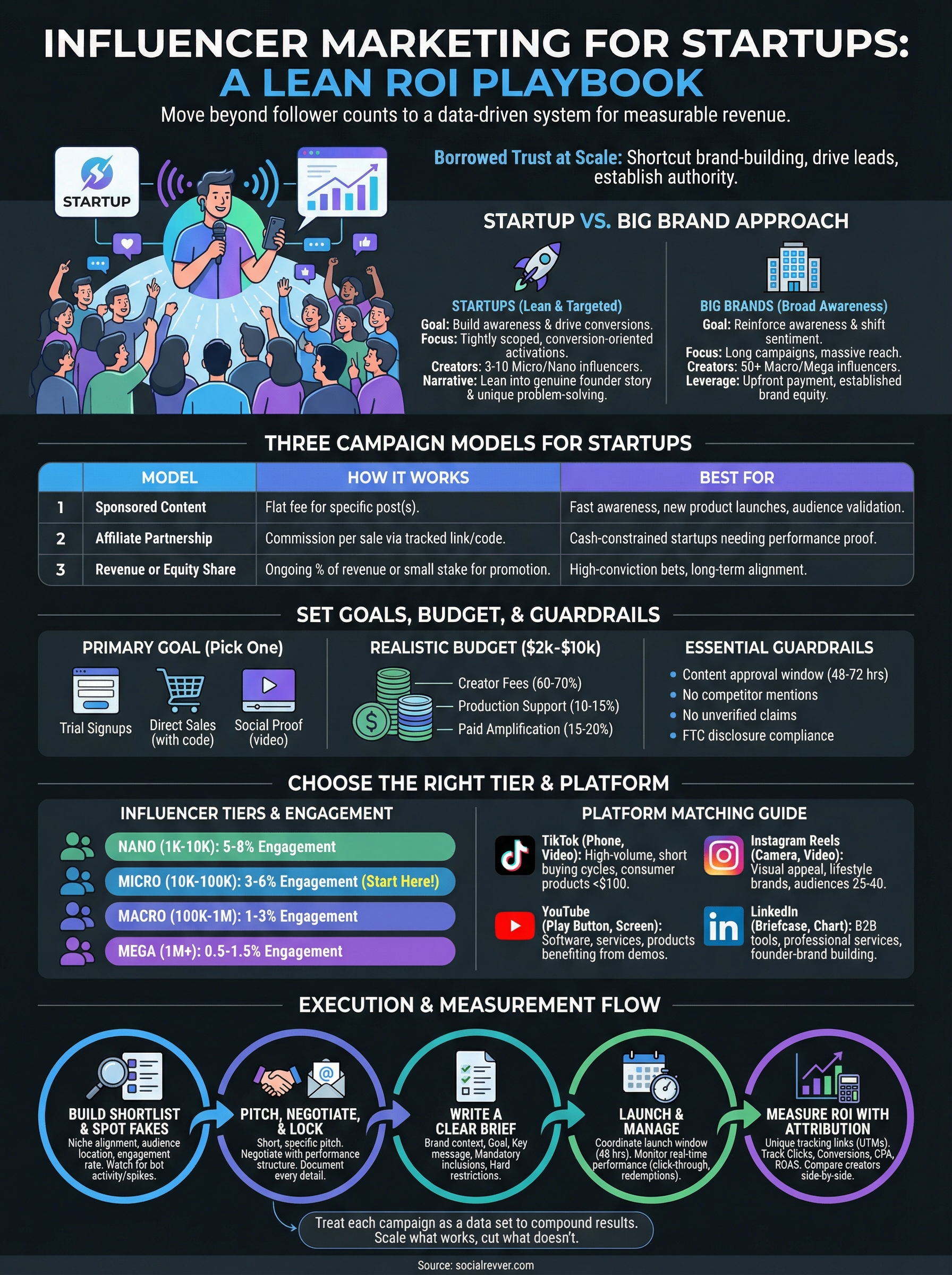
You now have a complete framework for influencer marketing for startups from goal-setting through attribution. The playbook only works if you execute it, so start with the smallest viable test: pick one platform, identify five micro-creators, send three pitches this week, and track every click with a unique UTM link.
Results compound when you treat each campaign as a data set, not a one-time activation. Your first campaign tells you which creator profile, content format, and CTA structure produces the lowest CPA. Your second campaign scales what worked and cuts what didn't.
The missing piece for most founders is the content infrastructure underneath: the short-form content system that captures influencer-driven attention and converts it into leads and customers consistently. If you want a proven growth architecture built around your brand, apply to work with SocialRevver and get a free 40+ slide social media strategy tailored to your business.