Most advice on how to increase social media engagement boils down to "post consistently" and "use trending audio." That's not strategy, that's guesswork dressed up as wisdom. The reality? Engagement isn't random, and the creators and founders seeing predictable results aren't just lucky. They're operating from a system.
At SocialRevver, we've analyzed over 750,000 videos to identify what actually drives interaction, not what sounds good in a LinkedIn thread. What we've found is that sustainable engagement growth comes from understanding behavioral triggers, not chasing algorithms. The platforms change constantly, but human psychology stays remarkably stable. That's where the leverage is.
This guide breaks down eight organic tactics that move the needle on likes, comments, shares, and saves, without paid promotion or growth hacks that expire next month. Each method is grounded in the same principles we use to build attention engines for business owners and creators who need their content to convert, not just perform. Whether you're a founder building authority or a creator scaling your reach, these strategies will give you a repeatable framework for building an engaged community that actually cares about what you post.
1. Use SocialRevver's managed content system
The fastest way to increase social media engagement is to stop treating content creation like a creative guessing game and start running it like a predictable system. Most creators and founders are stuck in a loop of manual posting, inconsistent quality, and zero feedback mechanism. They burn hours scripting and editing but have no framework to tell them what's actually working. A managed content system eliminates that waste by automating the strategy, production, and optimization layers that drive measurable results.
What a managed engagement system replaces
You stop relying on gut instinct for what makes a hook work or which topics deserve your attention. Instead, a data-backed framework takes over and identifies patterns in audience behavior before you ever hit record. The system also replaces manual editing workflows that drain your time and leave quality inconsistent. You no longer need to research trends, test formats, or guess what performs. The infrastructure handles that entire layer while you focus on being the face of your brand.
How SocialRevver's Attention Engine finds what works
SocialRevver's Attention Engine pulls from a database of over 750,000 analyzed videos to map behavioral triggers specific to your niche and audience. It identifies psychological patterns that predict completion rate, shares, and comments before production even starts. The engine cross-references your brand voice, your audience's existing engagement behavior, and high-performing structure archetypes to generate a custom content blueprint. This eliminates months of trial and error and gives you a repeatable playbook built from proven psychology, not popular opinion.
A data-driven content system removes the variance that kills engagement growth.
How the scripting and editing pipeline protects retention
SocialRevver's scripting engine writes conversion-focused scripts that match your voice while holding attention through every second. The AI-supported editing pipeline then optimizes cut timing, motion pacing, sound design, and captions to prevent drop-off. Each video gets treated like a product with measurable retention goals, not just a post. The result is content that looks professional and performs consistently, because every frame is engineered to keep viewers engaged through the call to action.
What to measure to prove engagement lift
Track completion rate and average watch time as your core retention signals. Monitor comments per view and save rate to understand how deeply people are connecting with your content. Measure share velocity in the first 24 hours to gauge viral potential and algorithmic distribution. Use profile visits and follower conversion percentage to confirm that engagement is translating into audience growth. These metrics tell you if your system is working or if you need to adjust strategy, creative, or distribution timing.
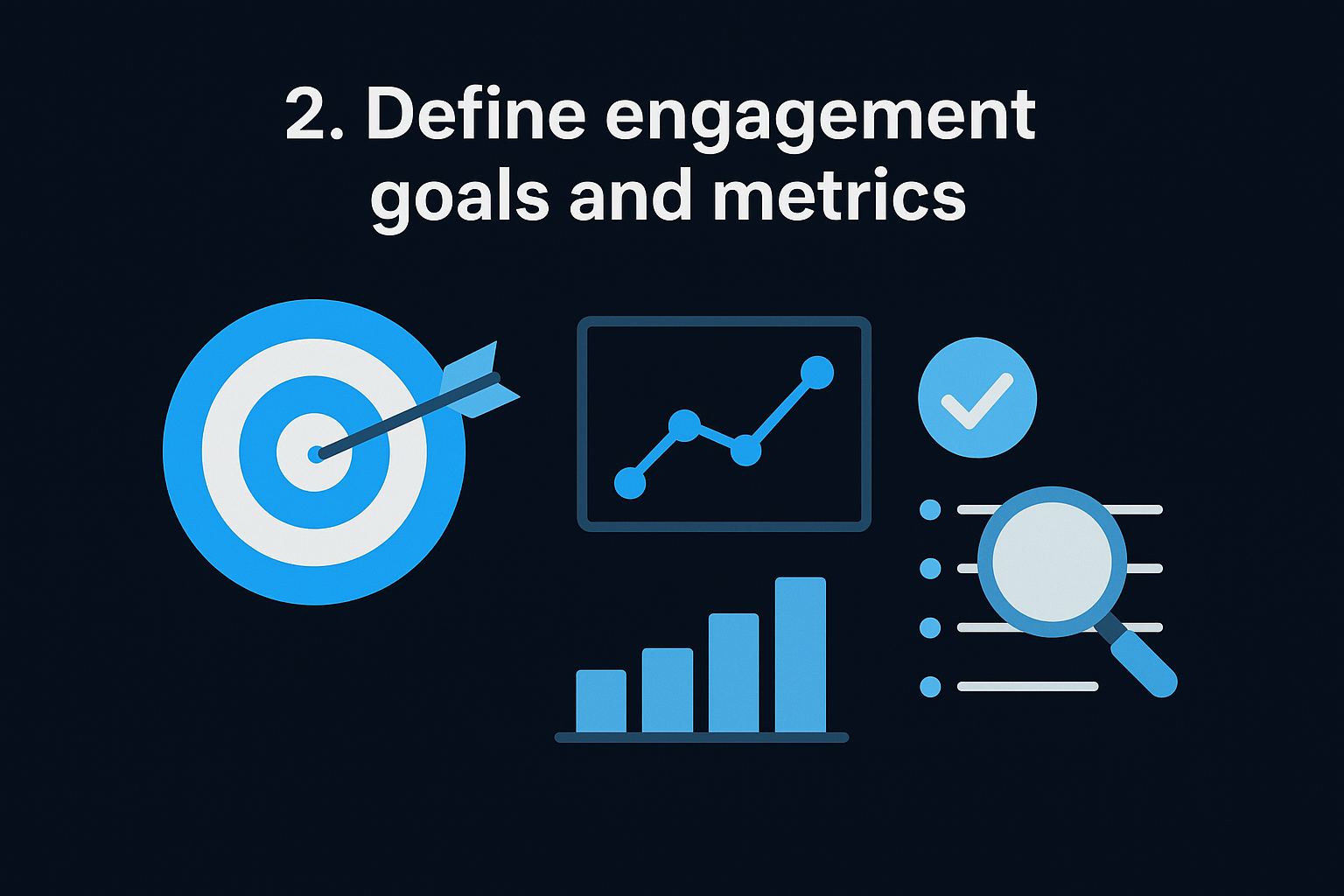
2. Define engagement goals and metrics
You cannot increase social media engagement if you're tracking everything and optimizing nothing. Most creators drown in vanity metrics while the numbers that actually predict revenue growth sit ignored in their analytics. The fix is simple: pick fewer goals, track them ruthlessly, and ignore the rest until your core engagement systems are running.
Pick one primary engagement goal per platform
Your primary engagement goal should match what the platform's algorithm rewards and what your business model needs. On Instagram, you might prioritize saves because they signal high value content that people want to reference later. LinkedIn might call for comment rate because conversations build authority faster than passive likes. Choose one metric per platform and design every piece of content to move that number. Chasing multiple goals simultaneously dilutes your creative focus and makes it impossible to identify what's actually working.
Choose the few metrics that actually reflect engagement
Stick to completion rate, comments per view, save rate, and share velocity. These four metrics tell you if people are watching, caring, and spreading your content. Profile visits and follower conversion rate matter only after your engagement baseline is strong. Likes and total views are lagging indicators that inflate your ego without predicting growth.
Track the metrics that predict algorithmic distribution, not the ones that feel good.
Set a baseline and a realistic target for 30 days
Pull your last 30 days of data for your chosen metric and calculate the average. Set a target that represents a 15 to 25 percent lift over that baseline. Anything higher creates pressure that leads to gimmicks instead of sustainable systems.
Build a simple reporting rhythm that you will stick to
Check your core metrics once per week, not daily. Build a spreadsheet or dashboard that shows your baseline, current performance, and target in one view. Weekly reviews let you spot patterns without reacting to noise.
3. Write hooks that earn watch time
The first three seconds of your video determine whether someone watches or scrolls, and weak hooks kill more good content than bad editing ever will. If you want to increase social media engagement organically, you need to stop opening with context, introductions, or slow builds. The hook is not a warmup, it's a promise that what comes next is worth their time. Your opening line should create immediate curiosity or tension that makes stopping feel like a loss.
Use a hook framework that fits your niche and voice
Pick a hook structure that aligns with how your audience thinks and what they value. Pattern-based hooks like "The thing nobody tells you about X" work for analytical audiences. Result-driven hooks like "I went from X to Y in Z days" perform for people chasing outcomes. Question hooks grab attention when the answer feels urgent or exclusive. Test three to five frameworks and double down on the one that consistently holds viewers past the first five seconds.
Tighten pacing and structure for completion rate
Cut every word that does not advance the narrative or deliver value. Your first sentence should land in under two seconds, and your second sentence should validate why they stayed. Trim pauses, filler words, and redundant setup so the hook flows directly into your core message. Structure your content so each segment earns the next ten seconds of attention.
A tight hook paired with fast pacing turns casual viewers into engaged followers.
Add pattern interrupts without feeling gimmicky
Use visual cuts, sound changes, or perspective shifts every seven to ten seconds to reset attention. Pattern interrupts work when they feel native to your content style, not like tricks borrowed from someone else's playbook. Text overlays, quick zooms, or B-roll inserts keep eyes on screen without breaking your authority.
Test hooks in batches and keep the winners
Post three variations of the same core content with different opening hooks and compare completion rates after 48 hours. Keep the hook that retains viewers longest and retire the underperformers immediately. Build a swipe file of your top five hooks and use them as templates for future content.
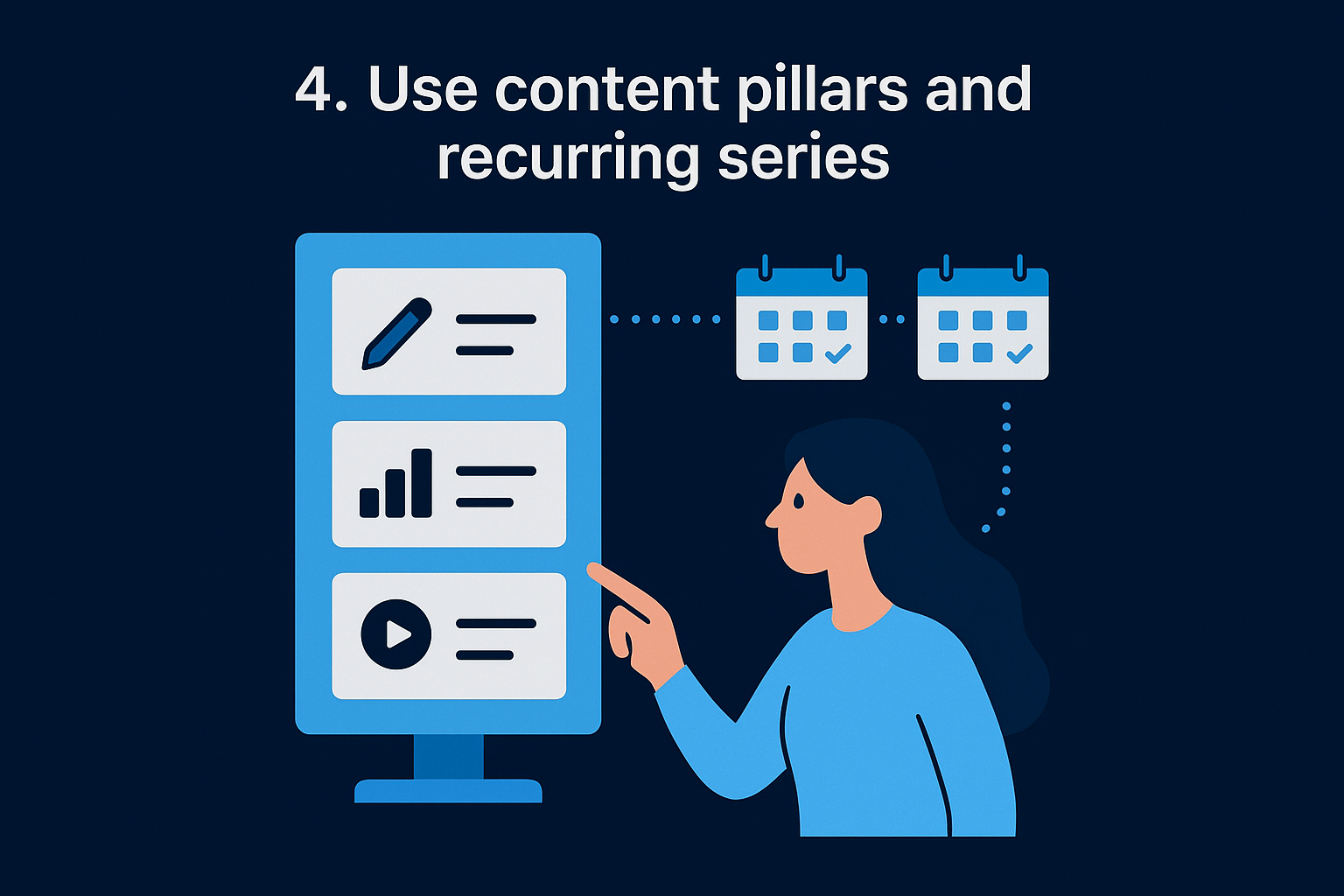
4. Use content pillars and recurring series
Random posting kills momentum faster than bad content ever will. When you scatter topics across unrelated subjects, your audience never knows what to expect, and the algorithm treats every post like a cold start. Content pillars give you a repeatable structure that trains both your audience and the platform to recognize your authority. People engage more when they know what they're getting, and recurring series turn casual viewers into subscribers who wait for your next post.
Choose 3 to 5 content pillars that match buyer intent
Your pillars should map directly to the problems your audience is actively trying to solve. If you sell a productivity tool, your pillars might cover workflow optimization, focus techniques, and remote work systems. Each pillar needs to align with a specific stage of buyer awareness so your content educates while moving people closer to conversion. Avoid vanity topics that feel brand-relevant but generate zero commercial intent.
Turn pillars into repeatable series people recognize
Build named series within each pillar that followers can anticipate and request. A founder might run "Revenue Breakdown Mondays" or "Founder Mistake Fridays" as recurring formats. Series create pattern recognition that boosts click-through rates because people develop habits around your content schedule.
Recurring series transform passive viewers into active participants who expect your content.
Balance authority, relevance, and personality
Your pillars should include one authority-building topic, one relevance-driven topic, and one personality-driven topic. Authority content establishes expertise, relevance content solves immediate problems, and personality content builds connection. This balance prevents your feed from feeling like a textbook or a diary.
Refresh pillars using what your comments and DMs reveal
Review your top-performing posts every 30 days and look for questions that appear repeatedly in comments. Use those questions to evolve your pillars so they stay aligned with what your audience actually cares about. Retire pillars that stop generating engagement and test new ones based on direct feedback.
5. Optimize for each platform's top signals
Generic content strategies fail because they ignore the fact that each platform rewards different behaviors. What drives engagement on LinkedIn will tank on TikTok, and Instagram prioritizes signals that YouTube Shorts ignores entirely. If you want to increase social media engagement, you need to design content around the specific metrics each algorithm uses to decide what gets distribution. Treating all platforms the same is the fastest way to build an audience nowhere.
Know what each algorithm rewards in 2026
Instagram prioritizes saves and shares over likes because they indicate high-value content. TikTok weights completion rate and rewatch behavior more heavily than any other metric. LinkedIn rewards dwell time and comment depth, not just reaction volume. YouTube Shorts focuses on watch-through rate and subscriber conversion. Study what each platform's recommendation system actually optimizes for and build content that feeds those signals instead of chasing vanity metrics that don't influence reach.
Design posts for saves, shares, and meaningful comments
Create content that people want to reference later or send to someone specific. Actionable frameworks, cheat sheets, and tactical breakdowns drive saves. Controversial takes and strong perspectives earn shares. Ask questions that require more than yes or no answers to generate comment depth. These behaviors signal value to the algorithm and extend your content's lifespan.
Platform algorithms amplify content that creates meaningful user actions, not passive consumption.
Match formats to platform behavior and feed placement
Use vertical video for Reels, Shorts, and TikTok because horizontal formats kill mobile watch time. Design LinkedIn carousels with text-heavy slides that encourage slower scrolling. Test static posts on Instagram when your topic benefits from longer captions and deeper storytelling.
Use native features to earn extra distribution
Post directly to each platform instead of cross-posting from a third-party tool. Use platform-specific features like Instagram's Add Yours stickers or LinkedIn's polls to trigger algorithmic favor. Native uploads and features consistently outperform imported content.
6. Create interactive posts people answer
Passive consumption does not build community, and high view counts mean nothing if nobody feels compelled to respond. The gap between content that people watch and content that people engage with comes down to friction and incentive. When you design posts that make interaction feel easy and rewarding, you transform silent viewers into active participants who boost your algorithmic reach. Interactive content is one of the most reliable ways to increase social media engagement because platforms prioritize posts that spark conversation.
Pick interaction formats that fit the platform
Instagram thrives on story polls, question stickers, and carousel prompts that encourage swipe-and-comment behavior. LinkedIn responds to text-based discussion posts and opinion requests that invite professional perspectives. TikTok rewards duets, stitches, and challenge formats that let users participate through their own content. Match your interaction format to how users naturally behave on each platform instead of forcing a format that feels out of place.
Write prompts that make responding easy
Ask specific questions with clear boundaries instead of vague open-ended prompts. "What's your biggest marketing challenge?" gets ignored, but "What's the one marketing task you avoid most?" gets answers. Use either-or questions, fill-in-the-blank formats, or ranking exercises that require minimal cognitive load to answer.
The easier you make it to respond, the more responses you get.
Use templates, polls, and Q and A to reduce friction
Provide pre-written response templates people can copy and customize. Use platform-native polling features that let users tap instead of type. Host Q and A sessions with submitted questions instead of live typing to lower the barrier to participation.
Turn responses into your next week of content
Screenshot high-quality answers and turn them into follow-up posts that credit the original commenter. Compile common themes from responses into dedicated videos or carousels that address what your audience actually cares about. Use DM conversations as script material for content that solves real problems.
7. Use proactive engagement and comment timing
Waiting for engagement to come to you is a losing strategy when you could be triggering it proactively. The creators who consistently increase social media engagement understand that interaction is a two-way system, not a broadcast channel. When you engage with your audience and peers before, during, and after posting, you signal to both humans and algorithms that your content deserves attention. Strategic timing turns those interactions into extended reach instead of isolated moments.
Do outbound engagement before you post
Spend 15 to 20 minutes engaging with your target audience's content in the hour before you publish. Comment on posts from accounts your ideal followers already watch. This activity warms up the algorithm and puts your profile in front of people who are already active. Your comments should add value, not beg for attention, so the interactions feel natural when those same users see your post minutes later.
Respond in a way that extends conversations
Reply to comments with questions or statements that invite further discussion instead of generic thanks. Turn one-line comments into multi-exchange threads that boost your post's engagement signals. Ask follow-up questions, request clarification, or share a related perspective that keeps the conversation moving.
Strategic responses transform single comments into conversations that multiply your engagement metrics.
Use comment timing to extend a post's lifespan
Respond to early comments within the first 30 minutes to maximize initial momentum. Save some responses for 6 to 12 hours later to trigger a second wave of algorithmic distribution. Platforms interpret renewed activity as a signal that your content still deserves reach.
Set boundaries and systems so it stays sustainable
Block two 15-minute windows daily for proactive engagement instead of constantly checking notifications. Use saved replies for common questions to speed up response time without sacrificing quality. Turn off notifications during deep work so engagement becomes intentional, not reactive.
8. Run a weekly optimization loop
One-time wins do not build sustainable growth, and random content experiments waste time you could spend scaling what already works. The best way to increase social media engagement long-term is to treat content like a product that gets iteratively improved based on real performance data. A weekly optimization loop turns your content operation from reactive posting into a feedback-driven system that compounds results over time. This process takes less than an hour per week but creates compounding advantages that separate growing accounts from stagnant ones.
Audit your top posts for repeatable patterns
Pull your top five performing posts from the last seven days and compare them for structural similarities. Look at hook phrasing, topic angle, visual style, pacing speed, and comment themes. Identify two to three patterns that appear across multiple winners instead of attributing success to isolated variables. Document these patterns in a running spreadsheet so you build a library of what actually converts for your specific audience. Your goal is to extract principles, not copy-paste formats.
Repurpose winners into new angles and formats
Take your highest-engagement post from the week and adapt it into three different formats or perspectives. A carousel can become a video script, a how-to post can become a mistakes-to-avoid post, and a text-based insight can become a visual comparison or case study. Repurposing multiplies the return on your research and creative effort while giving the algorithm multiple chances to distribute your best ideas.
Weekly optimization loops turn content performance from random to predictable.
Improve visuals, captions, and audio for scroll-stopping
Review underperforming posts and test one variable at a time to isolate what needs fixing. Swap thumbnail styles, rewrite the first sentence of captions, or replace background music to see if engagement shifts. Small tweaks to visual hierarchy, text size, or color contrast often unlock better performance without requiring full content rewrites.
Keep a testing backlog so you never guess what to post
Maintain a rolling list of 10 to 15 content ideas pulled from comment questions, DM requests, and competitor gaps. Rank them by potential impact and production effort so you always know what to create next. This backlog eliminates decision fatigue and ensures you post strategically instead of scrambling for ideas.
Keep the momentum
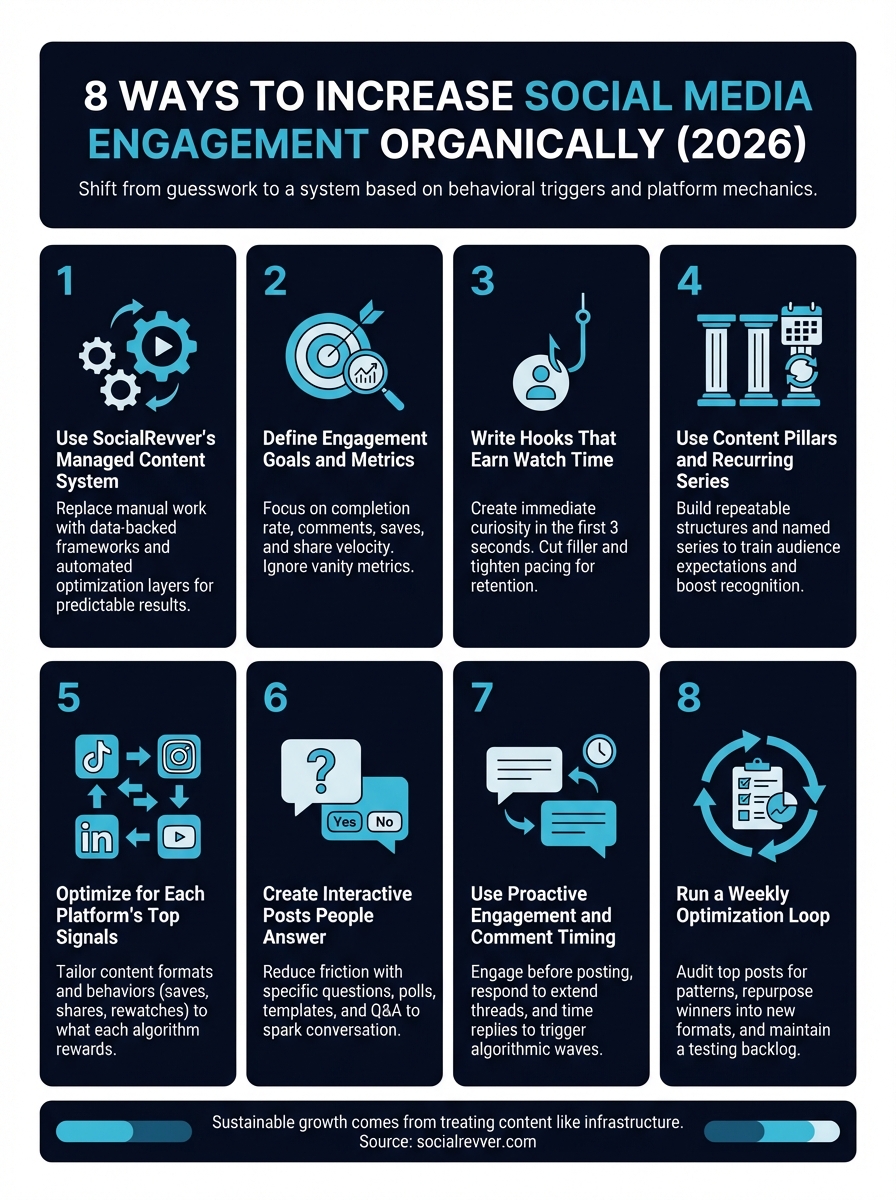
The eight strategies in this guide give you a repeatable framework for understanding how to increase social media engagement without guessing what works or burning hours on content that goes nowhere. Each method builds on behavioral triggers and platform mechanics that stay consistent even when algorithms shift. You now have tactical systems for hooks, content structure, platform optimization, and engagement loops that compound over time instead of delivering random spikes.
Sustainable growth comes from treating content like infrastructure, not inspiration. The creators and founders seeing predictable results run weekly optimization loops and measure the metrics that actually predict distribution. They build systems that remove variance and create compounding advantages month after month.
SocialRevver's team has built these exact systems for business owners and creators who need their social presence to generate revenue, not just vanity metrics. If you want a custom strategy that maps to your specific audience and business model, apply for a free 40+ slide social media strategy breakdown that shows you exactly what's holding your engagement back and how to fix it.