Most professionals think how to build a personal brand means picking nice colors, writing a clever bio, and posting whenever inspiration strikes. That approach worked in 2019. In 2026, it gets you ignored.
The people winning right now, the founders closing deals from a single video, the creators pulling six figures in inbound leads monthly, aren't doing anything random. They're running a system built on data, psychology, and consistency. Their brand isn't a side project. It's an engine.
That's exactly the problem we solve at SocialRevver. Every day, we help founders, business owners, and creators turn their personal brand into a predictable source of authority and revenue using our Attention Engine, a system that combines machine learning, behavioral science, and professional production. We've analyzed over 750,000 videos to understand what actually moves people to trust, follow, and buy. So what you're about to read isn't theory. It's built from patterns we see working across industries, right now.
This guide breaks down the full process, from defining your positioning and crafting a content strategy, to distributing at scale and converting attention into real business results. Whether you're a founder trying to attract investors and talent, or a creator looking to land better deals, every step here is designed to get you leads, not just likes. Let's get into it.
What a personal brand is in 2026
A personal brand in 2026 is not a logo, a color palette, or a clever bio. It's the specific reputation you hold in someone's mind before they ever speak to you. It's the reason a CFO picks up your call, a podcast host invites you on, or an investor takes your pitch seriously without needing a warm referral. When you learn how to build a personal brand the right way, you're building a system that does the qualifying and trust-building on your behalf, at scale, without you having to be in every conversation.
The market no longer rewards presence alone. It rewards recognizable authority that people can place in a category and actually remember.
Why the definition changed
Five years ago, a personal brand was mostly about visibility. You posted, you showed up consistently, and the algorithm rewarded frequency. That model no longer works. Attention has become the scarcest resource on the internet, and people scroll past hundreds of creators, founders, and professionals every single day. What separates the ones who stick from the ones who disappear is not how often they post. It's how precisely they occupy a mental slot in their audience's mind.
Think of it this way: when someone in your target market hits a specific problem, your name should surface. Not as one of ten options, but as the obvious answer. That only happens when your brand is built around a clear angle, a consistent message, and a system that reinforces both over time. The professionals generating real inbound in 2026 aren't posting randomly and hoping for traction. They're engineering the perception their audience holds about them.
The three layers of a modern personal brand
Most people build only one or two of these layers and then wonder why their brand isn't generating leads. A personal brand that converts in 2026 runs on all three working together simultaneously.
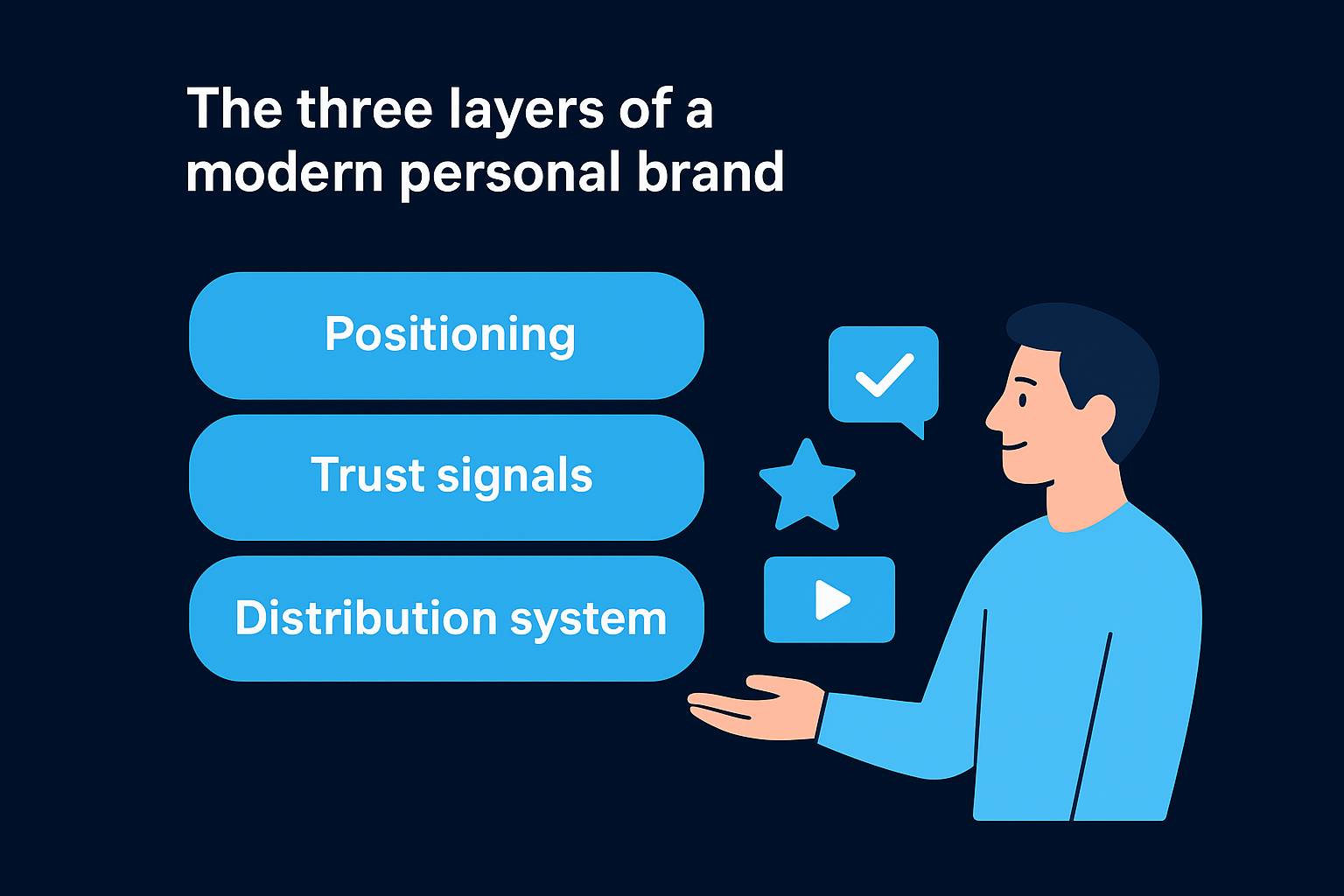
| Layer | What it does | What it looks like in practice |
|---|---|---|
| Positioning | Defines who you are for and what you solve | A niche statement, a content angle, a specific audience |
| Trust signals | Proves your authority before anyone asks | Case studies, consistent publishing, social proof |
| Distribution system | Gets your message in front of the right people | Short-form video, repurposed content, platform strategy |
Positioning tells people why they should care. Trust signals tell them why they should believe you. Distribution makes sure they actually see it. Skip any layer and the whole system leaks. Founders who only focus on positioning end up invisible. Creators who only focus on distribution end up known but not trusted enough to convert.
All three layers need to work in sequence to turn your brand into a lead source instead of a vanity project. The sections below walk you through each one in the order that actually produces results. Start with your positioning, because nothing else lands cleanly without it.
Step 1. Choose a clear positioning people remember
The first mistake most people make when figuring out how to build a personal brand is starting with aesthetics instead of strategy. Before you design anything, you need a positioning statement: a single, specific answer to "what do you do and for whom." Without it, your content, your bio, and your outreach all pull in different directions, and no one knows where to place you.
Positioning isn't about being the best. It's about being the only one who does what you do, for a specific person, in a specific way.
Narrow your niche to one specific audience
Most founders and creators resist narrowing down because they fear losing potential clients. The opposite happens. Broad positioning attracts no one because it gives the right person no reason to believe you're speaking directly to them. You want your target audience to read your bio and immediately think "this is exactly for me."
Start by answering three questions before you write a single word of content:
- Who are you talking to? ("SaaS founders under 50 employees" beats "entrepreneurs")
- What problem do you solve for them?
- What makes your approach different from the obvious alternatives?
Use a positioning template to lock it in
Once you've answered those three questions, compress the answers into a single statement you can place across every platform. Fill in this template directly:
I help [specific audience] achieve [specific outcome]
by [your unique method or angle],
without [common pain point or trade-off].
Example: "I help B2B founders build inbound pipelines through short-form video, without spending hours a week on content."
Your positioning statement becomes the foundation for your bio, your content angle, and your pitch. Every piece of content you produce should reinforce it in some way. If a video you're planning doesn't connect back to your positioning, cut it or reshape it until it does. Consistent reinforcement is what turns a scattered presence into a recognizable brand people actually remember and refer to others.
Step 2. Build trust signals and a simple brand narrative
Positioning tells people who you are. Trust signals are what make them believe it. When someone lands on your profile or watches your content for the first time, they run a fast, unconscious credibility check. Your job is to make that check easy to pass. Trust isn't built in one post. It's built through consistent, visible proof that you've done what you say you do.
What trust signals actually mean
A trust signal is any element on your profile, in your content, or across your digital presence that answers the question "why should I believe this person?" without you having to say it out loud. The strongest trust signals are specific, not vague. "I've helped 40 SaaS founders hit their first $1M ARR" lands harder than "I help founders grow." Numbers, results, and named outcomes do the heavy lifting that testimonials alone can't.
The fastest way to lose credibility is to claim authority with no evidence. Specificity is the proof.
Here are the core trust signals to build into your presence from the start:
- Case study clips or results posts that show a before/after outcome for a real client or project
- Consistent publishing history that signals you're not a flash in the pan
- Third-party validation like podcast appearances, press mentions, or speaking slots
- Specific credentials or experience stated plainly in your bio and pinned content
Write your brand narrative in three lines
Understanding how to build a personal brand means knowing that your story needs to fit into three lines, not three paragraphs. Most people over-explain. Your audience decides in seconds whether you're worth their attention. Use this template directly on your profiles:
Line 1: Who you help and what you help them achieve
Line 2: How you do it differently (your method or background)
Line 3: One specific result or proof point
Example: "I help e-commerce founders grow without paid ads. I use short-form content systems built on behavioral data. Clients average 3x inbound leads in 90 days."
Keep it tight, specific, and repeatable across every platform you use.
Step 3. Publish with a short-form content system
Positioning and trust signals mean nothing if the right people never see them. Publishing consistently is where most founders and creators fall apart, not because they lack ideas, but because they treat content as a creative task instead of a repeatable production process. A short-form content system removes the guesswork and replaces it with a weekly rhythm you can actually maintain without it consuming your business hours.
Pick one format and own it
Short-form video is the highest-leverage format available right now for anyone learning how to build a personal brand that generates real inbound. TikTok, Instagram Reels, and YouTube Shorts all surface your content to audiences who have never heard of you, without requiring an existing following to get traction. Pick one platform where your target audience already spends time, and commit to it fully before you expand anywhere else.
Spreading yourself across five platforms at 20% effort produces worse results than owning one platform at full capacity.
Use a repeatable weekly content structure
Structure is what makes consistency possible. Without a set framework, every piece of content becomes a blank-page problem that drains your time and energy. Use this weekly template to keep your output predictable and your message reinforced across every post:
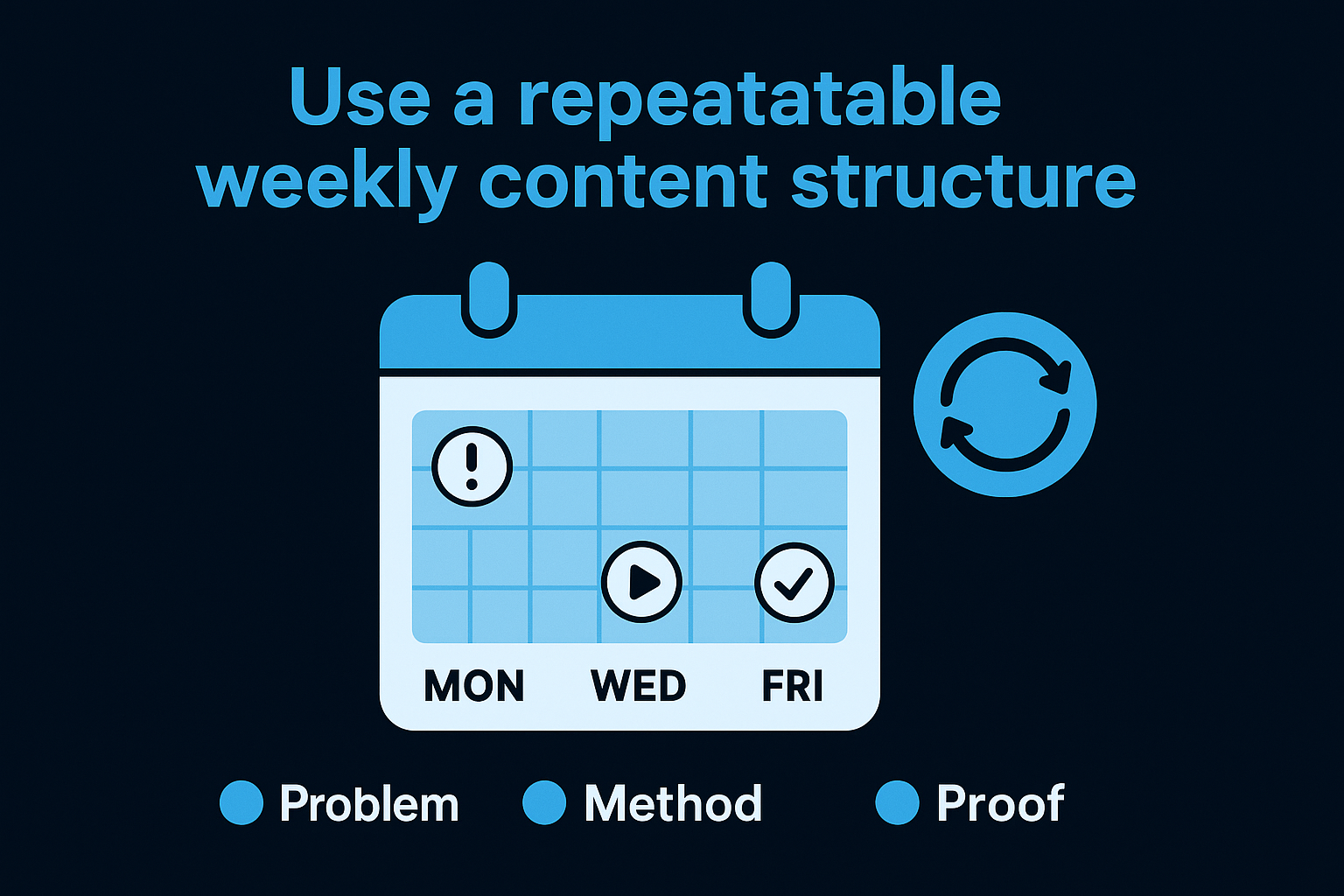
Monday:    Problem post (lead with a pain your audience feels daily)
Wednesday: Method post (show your specific approach or process)
Friday:    Proof post (a result, case study, or lesson from real work)
Rotating through problem, method, and proof keeps your content varied while staying locked to your positioning. Every post type serves a different stage of your audience's trust journey, so nothing you publish is wasted.
Batch your production to stay consistent
Batching your content creation into one dedicated block per week is the single biggest operational shift that separates professionals who stay consistent from those who burn out after six weeks. Set aside three to four hours, script your three posts, record them back to back, and hand editing off or use a structured workflow. Your role is to run the system, not to act as a full-time content creator.
Step 4. Convert attention into leads without feeling salesy
Getting attention is only half the job. If you've worked through how to build a personal brand using the steps above, you now have positioning, trust signals, and a publishing system that puts you in front of the right audience consistently. What most founders and creators miss is the conversion layer: the simple, repeatable way to move someone from viewer to lead without turning your content into a sales pitch. The good news is that you don't need to be pushy to generate inbound. You need to make the next step obvious.
People who already trust you don't need to be sold. They need to be directed.
Make your call-to-action one clear next step
The biggest conversion mistake is asking your audience to do too many things at once. One call-to-action per piece of content will always outperform a list of options. Pick a single low-friction entry point and repeat it consistently across your posts. The goal is to give someone who's ready to move forward an immediate, obvious path to take.
Use this template directly in your content and bio:
If you want [specific outcome],
[action they take] and [what happens next].

Example:
"If you want a content system that generates inbound leads,
send me a DM with 'system' and I'll walk you through what that looks like for your niche."
Keep the action simple and specific. A short reply, a link to a booking page, or a free resource all work. What matters is that you pick one and repeat it until it becomes associated with your name.
Use your content to qualify before you pitch
Your content should do the filtering work before anyone lands in your inbox. When your posts speak directly to a specific audience with a specific problem, the people who respond are already pre-qualified. You're not chasing leads. You're attracting the right ones by being precise about who you help and what outcome you deliver. That specificity is what separates a personal brand that generates revenue from one that only generates followers.
Put your brand into motion
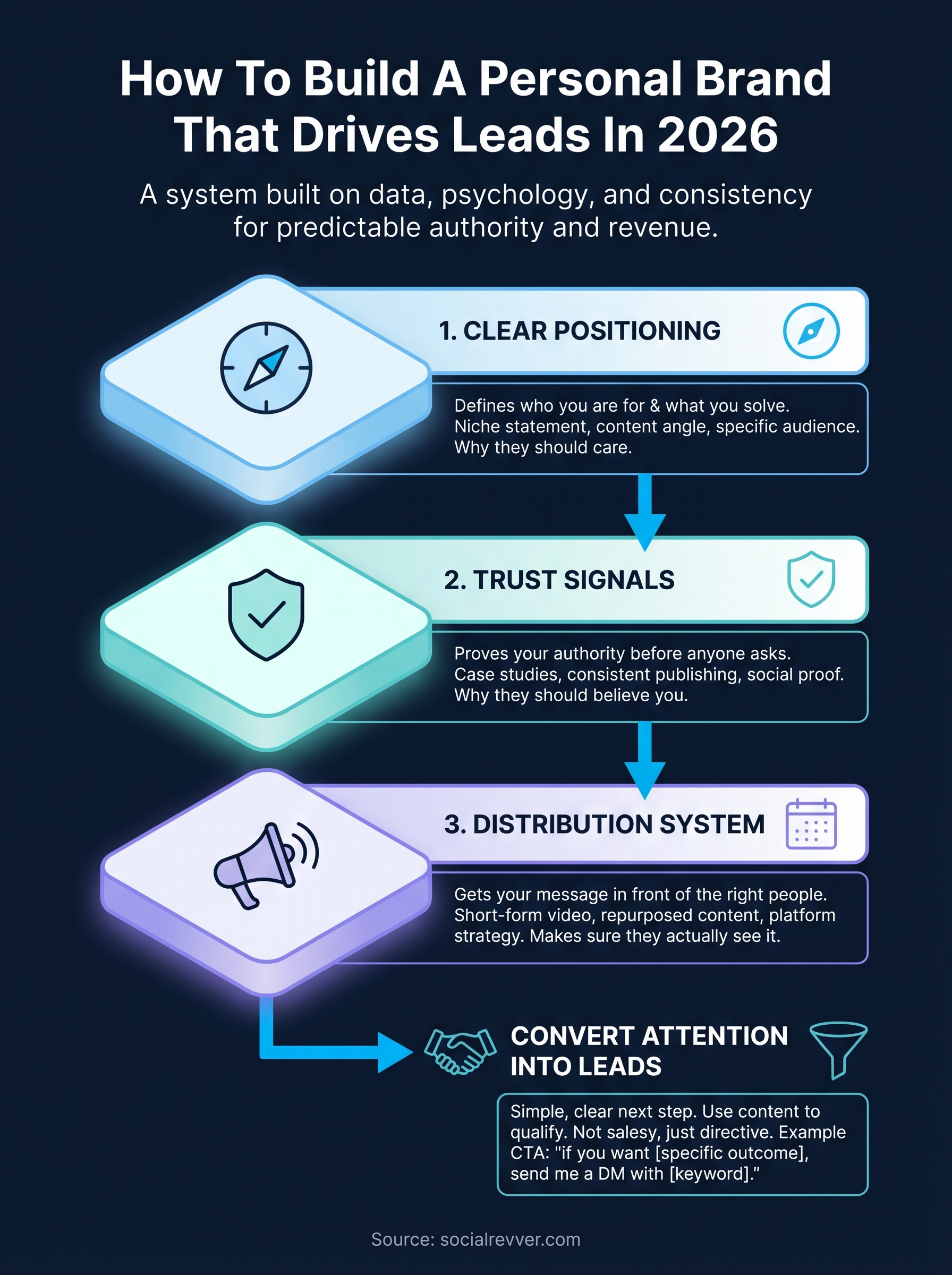
You now have everything you need to understand how to build a personal brand that generates real inbound leads. Positioning, trust signals, a publishing system, and a conversion layer are the four pieces that work together to turn your name into a business asset. The problem isn't knowing what to do. It's doing it consistently at a level of quality that actually moves people to trust and buy from you.
That's where most founders and creators stall. Execution without infrastructure produces inconsistency, and inconsistency kills authority faster than anything else. If you want a done-for-you system that handles strategy, scripting, production, and distribution, our team at SocialRevver builds exactly that.
Apply for your free 40+ slide social media strategy and we'll map out the exact content system your brand needs to start generating leads.