
Every Pixar film, from Finding Nemo to Up, follows a deceptively simple narrative formula called the Pixar story structure, also known as the Story Spine. It's a sequence of connective phrases ("Once upon a time…", "Every day…", "Until one day…") that locks audiences into an emotional arc whether the story runs two hours or sixty seconds.
That last part matters more than most creators realize. The same structural principles that make a Pixar movie unforgettable also drive the short-form content we build at SocialRevver, because a script that nails tension, stakes, and resolution in under a minute isn't guessing. It's engineering story mechanics. And the Story Spine is one of the clearest blueprints for doing exactly that.
This article breaks down each stage of the Story Spine, the rules behind it, and concrete examples so you can start applying the framework to your own writing, scripts, or content strategy.
What the Pixar story structure is
The Pixar story structure is built on a framework called the Story Spine, originally developed by improv theater practitioner Kenn Adams in the early 1990s. Pixar's story development team adopted and refined it as an internal creative tool for building emotionally coherent narratives. The framework gives writers a skeleton of cause-and-effect sentences that force every scene and every story beat to earn its place in the overall arc.
Where it came from
Adams created the Story Spine as a structured improv exercise designed to help performers build narratives in real time without losing logical flow. Each line in the spine begins with a specific connective prompt that links one beat directly to the next. Pixar's story artists recognized that the same constraint-based thinking helping improv actors stay on track could also help film writers avoid the most common structural mistakes: unearned emotional payoffs, unclear stakes, and meandering second acts.
The Story Spine doesn't restrict creativity. It channels it toward a structure that human brains are already wired to follow.
What makes it different from other story frameworks
Most story frameworks, like the hero's journey or the three-act structure, describe story shape in broad, abstract phases. The Story Spine works differently because it operates at the sentence level, requiring you to state cause and effect explicitly at each beat. You can't skip the "because of that" connective without immediately noticing the gap in logic.
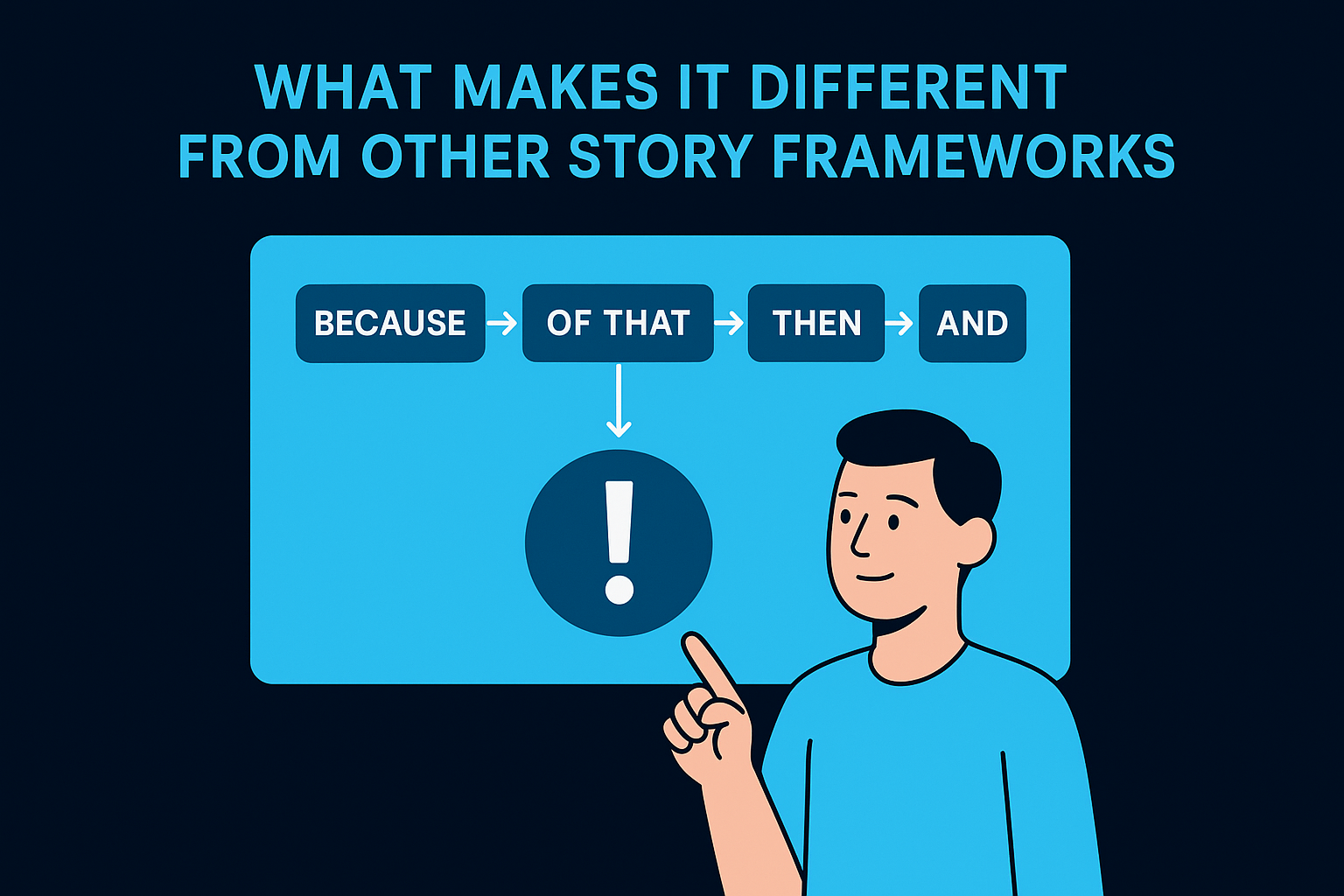
That built-in accountability makes the framework especially powerful for short-form content. Here's where it separates itself from other frameworks:
- It forces explicit causality between every beat
- It surfaces missing stakes before you finish the first draft
- It works at any content length, from a two-hour film to a sixty-second script
The Story Spine stages explained
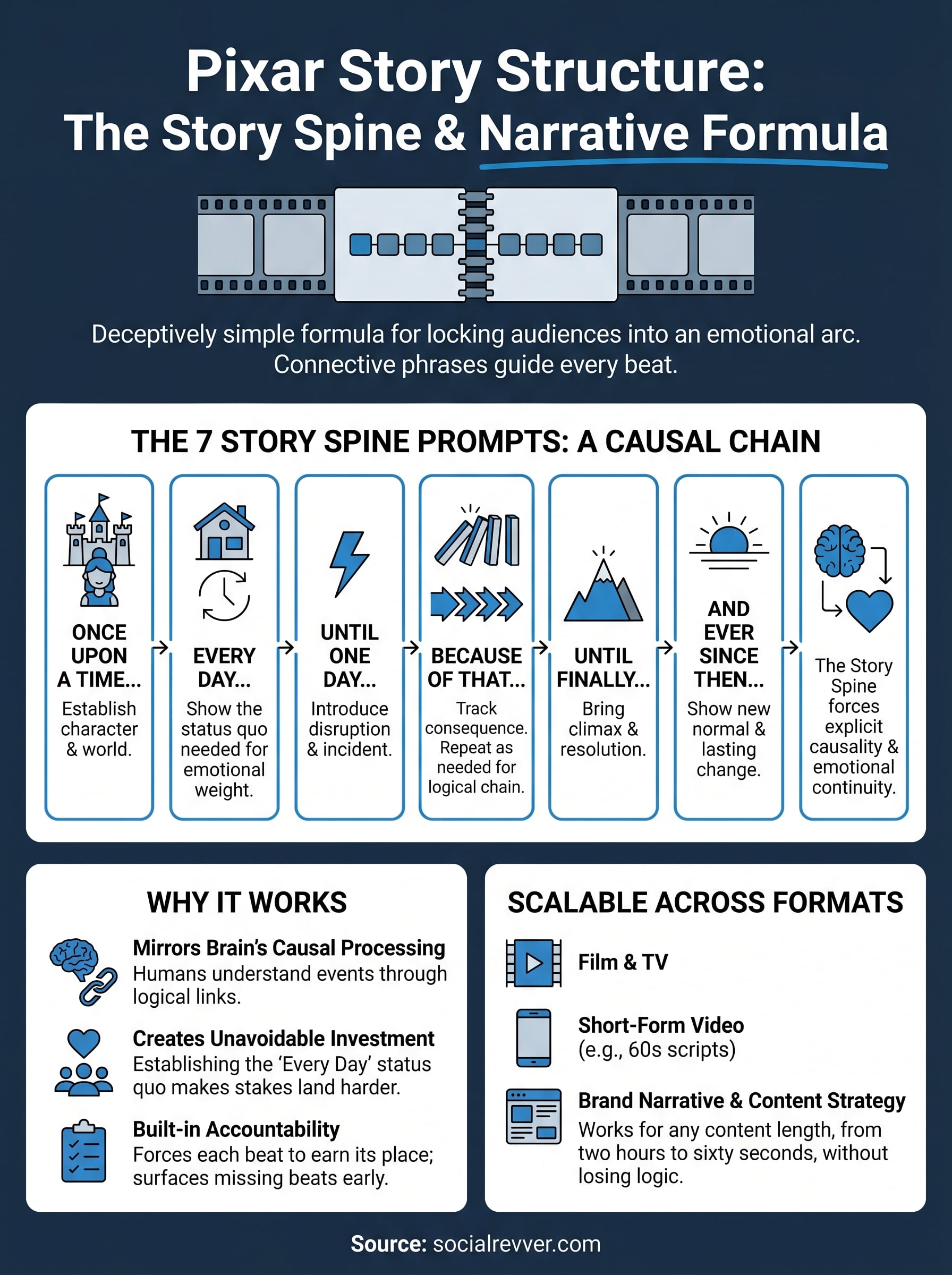
The Story Spine moves through seven connective prompts, each building directly on the last. Together, they cover every essential story function: establishing a world, introducing disruption, tracking consequence, and landing an earned resolution. The Pixar story structure works because each prompt forces logical, emotional continuity from start to finish.
The seven prompts
Here are the prompts and the function each one serves:
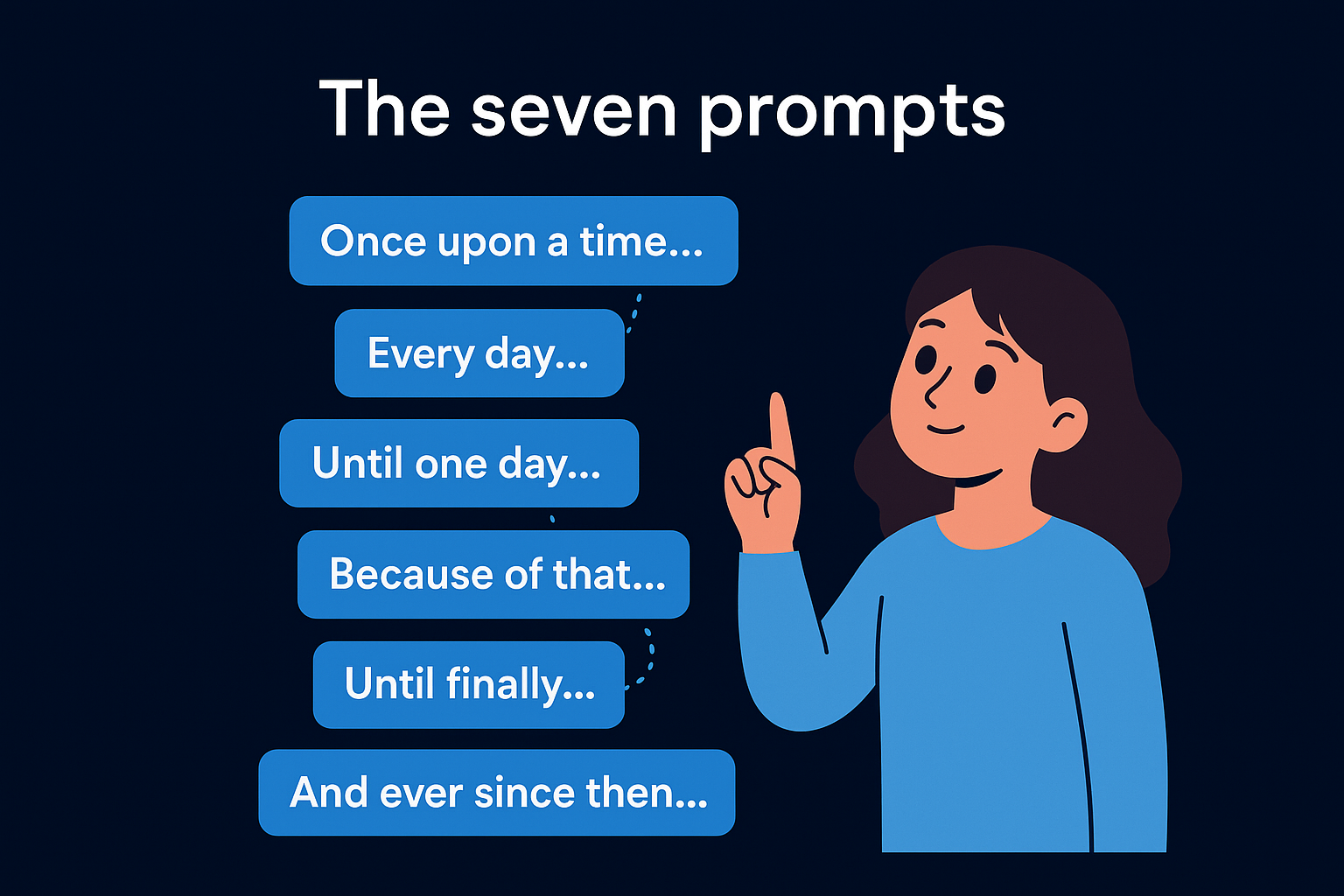
- Once upon a time... establishes your character and their world
- Every day... shows the status quo your audience needs to feel before it breaks
- Until one day... introduces the disrupting incident
- Because of that... tracks consequence (repeat this prompt as needed to build a cause-and-effect chain)
- Until finally... brings the climax and resolution
- And ever since then... shows the new normal and what permanently changed
The "Because of that" prompt is the real engine of the structure. It forces each beat to cause the next one, which is exactly what prevents a story from meandering.
Each prompt also works as a diagnostic tool for your scripts. If you struggle to complete any single line, that gap points directly to a missing story beat before you waste time building content on a flawed foundation.
Why the Story Spine works so well
The Story Spine succeeds because it doesn't fight how human brains work. It aligns directly with the way people process cause, consequence, and change, which are the three things your audience unconsciously tracks every time they watch, read, or listen to a story.
It mirrors how the brain processes stories
Cognitive science research consistently shows that humans understand events through causal chains, not isolated moments. The Story Spine builds that chain into its structure by design. Every prompt you complete forces a logical link between what happened and what happens next, which keeps your audience oriented and emotionally engaged without any extra effort.
When a story follows causal logic, audiences stop consuming it and start experiencing it.
It creates unavoidable emotional investment
The pixar story structure works in large part because the "Every day" stage does something most frameworks skip entirely: it makes your audience care about the status quo before you break it. Without that baseline, disruption carries no weight.
By the time you reach "Until one day," your audience already has skin in the game, which means the stakes land harder and the resolution pays off in full.
How to write with the Pixar structure
Applying the pixar story structure to your writing starts with one rule: complete each prompt in order before drafting finished content. Skipping ahead breaks the causal chain and leaves your script feeling disconnected, even when individual moments are strong.
Start with your character's normal world
The "Once upon a time" and "Every day" prompts deserve more attention than most writers give them. Define what your character wants and what their daily routine looks like before you introduce any conflict.
Your audience needs to feel the weight of what exists before you take it away. Specific, grounded details at this stage build the emotional investment that every later beat depends on.
Build your cause-and-effect chain first
Before writing a single finished line, map each "Because of that" connection as a plain sentence. Doing this forces you to confirm that every beat logically earns its place in the sequence.
If you can't state the causal link in one sentence, you have a structural gap, not a creative block, and you can fix it before production starts.
Resolving that gap at the outline stage saves significant revision time and keeps your final script tight from the beginning.
Examples and variations you can copy
Seeing the pixar story structure in action makes it much easier to apply to your own work. The examples below show how the framework adapts across different content formats, from short-form video scripts to brand authority content.
A short-form video script example
The spine maps cleanly to a 60-second founder story. Each prompt gives you one concrete beat, and the entire arc compresses without losing logic or emotional weight.
- Once upon a time: A startup founder struggled to attract investors
- Every day: She sent cold emails and got no responses
- Until one day: She posted one short-form video sharing her process
- Because of that: Three investors reached out within 48 hours
- Until finally: Her inbound pipeline replaced cold outreach entirely
- And ever since then: She only takes meetings from referrals and inbound
The structure doesn't change when you shorten the format. The stakes and resolution still carry the same emotional weight.
Adapting the spine for your niche
You can swap the character from a person to a company, a product, or even your audience. The connective prompts stay identical regardless of what you plug in.
Switching the character type also shifts whose perspective your audience takes. When your audience sees themselves as the protagonist, emotional investment increases and your content performs better.
Final recap
The pixar story structure gives you a concrete, repeatable system for building stories that land every time. Each stage of the Story Spine forces explicit cause-and-effect logic between beats, which means your audience stays emotionally invested from the first line to the resolution. That's not a creative accident. It's a structure working exactly as designed.
What makes this framework valuable beyond screenwriting is its scalability across formats. You can apply the same seven prompts to a founder origin story, a brand narrative, or a 60-second video script, and the emotional mechanics still hold. The structure doesn't change with format. Only the subject, length, and character do.
If you want a content system that applies frameworks like this at scale, apply to work with the SocialRevver team and get a free 40+ slide social media strategy built around data-driven storytelling that converts attention into consistent inbound growth.