Most brands blend in because they never decided what makes them different. They skip positioning entirely, or worse, they copy a competitor's messaging and wonder why nothing clicks. If you're searching for brand positioning examples, you're already ahead of most founders who treat their brand like an afterthought while expecting premium results from generic messaging.
At SocialRevver, we build content systems that turn organic social into a revenue engine, but none of that works if the brand behind the content has no clear position. Every script we write, every hook we test across our database of 750,000+ videos, ties back to one thing: a distinct point of view that makes people stop scrolling. Without sharp positioning, even the best production and distribution fall flat.
This article breaks down 10 real companies that nailed their brand positioning, across industries, price points, and audience types. You'll see exactly what they did, why it worked, and how to apply those principles to your own brand. At the end, you'll find plug-and-play templates so you can draft your own positioning statement today, not next quarter. No theory-heavy fluff, just patterns you can steal and put to work.
1. SocialRevver
SocialRevver operates in a crowded market full of social media agencies, content studios, and freelance editors. Most of them sell creativity. SocialRevver sells a predictable growth system built on data from over 750,000 videos, which is a fundamentally different offer. That distinction does not happen by accident. It comes from a deliberate positioning decision to compete on engineering instead of artistry.
The brand's positioning in one line
SocialRevver is the content infrastructure company for founders and business owners who want to turn short-form social into a revenue channel without becoming full-time content creators.
This single line does a lot of work. It names a specific audience, identifies the outcome they want, and removes the objection that scaling content requires the founder to do more work personally.
What SocialRevver anchors that position on
The position rests on three pillars: machine learning applied to human psychology, a proprietary scripting engine, and a fully managed production pipeline. Each of these signals that SocialRevver is not selling creative services. It is selling a technical system with repeatable outputs, which is a completely different category of promise. That framing filters out clients who want cheap content and attracts high-level professionals who want measurable business results.
The strongest brand positions do not try to appeal to everyone. They use specificity to attract the right buyers and repel the wrong ones.
Where the positioning shows up in the real world
You see this position in every layer of how SocialRevver communicates. The language on the site talks about attention engines, behavioral science, and conversion architecture rather than "engaging posts" or "growing your audience." The service framing leads with process and data, not portfolio aesthetics. Even the name implies acceleration through a structured system, not passive growth from posting more often. These are deliberate word choices that reinforce a single, consistent market position across every touchpoint.
Template you can copy
Use this structure to draft your own positioning statement:
"For [specific audience], [brand] is the [category] that [unique differentiator], because [proof or mechanism]."
SocialRevver's version: "For founders and business owners, SocialRevver is the content infrastructure system that converts organic short-form social into predictable revenue, because it replaces manual creative work with a machine-learning-driven production engine."
How to adapt it to your brand
Start by naming your specific audience with as much precision as possible. Generic audiences produce generic positioning. Then identify the one mechanism that makes your approach different from every competitor offering a similar result. If you are studying brand positioning examples to sharpen your own statement, the key move is to anchor your position on what you do differently, not just what you do better. "Better" is a claim anyone can make. "Different" requires a real structural choice about who you serve and how you serve them.
2. Apple
Apple sells hardware in a market where dozens of competitors offer similar specs at lower prices. What separates Apple is not the technology inside the box. It is a consistent identity built around design and simplicity, two values Apple has defended for decades without compromise. That deliberate choice to compete on experience rather than price turned Apple into the most valuable brand in the world.
The brand's positioning in one line
Apple is the premium technology brand for people who treat design and simplicity as requirements, not optional features.
What Apple anchors that position on
Apple anchors its position on design philosophy and a tightly integrated product ecosystem that rewards loyalty. The brand never leads with specs or price comparisons. It leads with the feeling of using the product, a category competitors struggle to replicate even when they match the hardware.
Competing on experience instead of features creates a position competitors cannot simply copy by lowering their price or improving their specs.
Where the positioning shows up in the real world
You see this position in Apple's minimalist retail environments, product packaging, advertising, and every launch keynote. Apple rarely opens with technical specifications. It opens with the human story behind the product. Every touchpoint pushes the same message in the same direction.
Template you can copy
"For [audience], [brand] is the [category] built on [core value], so that [desired outcome]."
Apple's version: "For people who value design and simplicity, Apple is the premium technology brand built on obsessive craft, so that using technology feels effortless."
How to adapt it to your brand
When you study these brand positioning examples, notice that Apple never hedges its identity to chase a broader market. Pick one core value your audience already believes in, then build every customer touchpoint around it consistently. If your positioning statement needs more than two sentences to explain itself, cut it down further.
3. Tesla
Tesla entered a market dominated by legacy automakers with century-old distribution networks, dealer relationships, and brand recognition. Rather than compete on those terms, Tesla repositioned the entire category around technology and sustainability, making every traditional car company look like it was playing catch-up.
The brand's positioning in one line
Tesla is the premium electric vehicle brand for buyers who want cutting-edge technology and environmental impact without sacrificing performance.
What Tesla anchors that position on
Tesla builds its position on software-first engineering and a direct-to-consumer sales model that bypasses dealerships entirely. That structural choice signals something deeper: Tesla is a technology company that builds cars, not a car company that added an app. That distinction shapes how buyers perceive every product decision Tesla makes.
When your positioning reframes the category itself, you stop competing and start defining what the new standard looks like.
Where the positioning shows up in the real world
Tesla's over-the-air software updates, minimalist interiors, and direct retail stores all reinforce the same message. No dealership negotiation, no cluttered dashboards, no combustion engine noise. Every physical and digital touchpoint removes friction and signals that technology leads the brand identity.
Template you can copy
"For [audience], [brand] is the [category] that [reframes the standard], because [structural differentiator]."
Tesla's version: "For performance-driven buyers, Tesla is the electric vehicle brand that reframes what a car can be, because it treats software as the product and hardware as the delivery mechanism."
How to adapt it to your brand
When you study these brand positioning examples, look for how Tesla repositioned the entire category, not just its place in it. Ask yourself whether your brand is competing within an existing category or redefining what the category means for your specific audience.
4. Nike
Nike competes in athletic apparel against hundreds of brands offering comparable quality at lower prices. Instead of competing on specs or price, Nike built its entire identity around one psychological trigger: the belief that every person has an athlete inside them. That single idea has driven consistent positioning for over four decades without losing its edge.
The brand's positioning in one line
Nike is the athletic brand for anyone who pushes past personal limits, regardless of skill level or sport.
What Nike anchors that position on
Nike anchors its position on human motivation and athletic identity, not product features. The brand rarely leads with shoe technology or fabric quality. It leads with the internal struggle of choosing to act, which makes every person who has ever pushed themselves feel like a Nike customer. That emotional anchor is far harder to compete against than any material specification.
Positioning built on a shared identity outlasts any product feature because identity does not become obsolete when a competitor improves their specs.
Where the positioning shows up in the real world
You see this position in Nike's athlete endorsements, campaign storytelling, and the three-word tagline that needs no explanation. Every ad focuses on effort, struggle, and the decision to move forward, with the product shown as the tool that gets you there, not the reason you try.
Template you can copy
"For [audience], [brand] is the [category] for people who [identity statement], because [emotional anchor]."
Nike's version: "For anyone who competes, Nike is the athletic brand for people who choose to push past their limits, because every athlete deserves gear built for that decision."
How to adapt it to your brand
When you study these brand positioning examples, notice that Nike never limits its audience to professional athletes. Pick the identity your audience wants to claim, then position your brand as the one that validates and enables it. That move pulls your brand out of product comparison entirely.
5. Patagonia
Patagonia sells outdoor gear in a market full of technically capable competitors. What separates Patagonia is not the quality of its fleece or the durability of its jackets. It is a brand built on a genuine mission to protect the environment, a position so consistent and deeply embedded that customers treat buying Patagonia as a form of personal values alignment, not just a retail transaction.

The brand's positioning in one line
Patagonia is the outdoor apparel brand for environmentally conscious buyers who want gear built to last and backed by a company that actively fights for the planet.
What Patagonia anchors that position on
Patagonia anchors its position on radical corporate transparency and a documented commitment to environmental activism. The brand donates a percentage of sales to environmental causes and has publicly told customers to buy less of its products if they do not need them. That kind of counter-marketing only works when the mission behind it is credible.
A brand that genuinely acts on its stated values builds trust no advertising budget can replicate.
Where the positioning shows up in the real world
Patagonia's repair program, recycled materials, and activist marketing campaigns all push the same message. The brand's decisions consistently prioritize environmental impact over short-term revenue, which reinforces the position every time a customer interacts with it.
Template you can copy
"For [audience], [brand] is the [category] that [mission-driven differentiator], because [proof of commitment]."
Patagonia's version: "For environmentally conscious buyers, Patagonia is the outdoor gear brand that treats every product decision as an environmental one, because the mission comes before the margin."
How to adapt it to your brand
When you study these brand positioning examples, notice that Patagonia does not claim a mission. It demonstrates one through consistent, costly decisions that prove the position is real. If you want to anchor your brand on a value, make sure your operations actually reflect it before you build your messaging around it.
6. Trader Joe's
Trader Joe's competes in a grocery market dominated by national chains with broader selections and larger marketing budgets. Rather than fight on those terms, Trader Joe's built a distinct identity around discovery and value, creating a shopping experience customers recommend without any paid advertising driving it. That word-of-mouth loyalty is the direct result of a clear, consistently executed brand position.
The brand's positioning in one line
Trader Joe's is the specialty grocery brand for curious, budget-conscious shoppers who want unique, high-quality products without paying premium-store prices.
What Trader Joe's anchors that position on
Trader Joe's builds its position on private-label exclusivity and radical product curation. The store carries a fraction of the SKUs a typical supermarket stocks, which forces every product on the shelf to earn its place. That scarcity signals quality and keeps customers returning to see what is new, turning the store itself into the experience.
When you reduce choice deliberately, you signal confidence in what you kept.
Where the positioning shows up in the real world
You see this position in Trader Joe's hand-drawn signage, nautical store design, and employee culture that prioritizes conversation over transaction. The brand runs no traditional advertising. Its newsletter, the Fearless Flyer, reads like a food magazine, not a coupon book. Every detail reinforces the same message: this store is different by design.
Template you can copy
"For [audience], [brand] is the [category] that [curation-based differentiator], because [proof of commitment]."
Trader Joe's version: "For value-driven food explorers, Trader Joe's is the specialty grocery brand that treats every product as a deliberate choice, because the shelf space is too limited for anything ordinary."
How to adapt it to your brand
When you study these brand positioning examples, notice that Trader Joe's uses limitation as a feature. Identify what your brand deliberately excludes or refuses to do, then frame that constraint as a positioning signal. Saying no to the wrong customers sharpens your appeal to the right ones.
7. Dollar Shave Club
Dollar Shave Club entered a razor market controlled by Gillette, a brand with decades of retail dominance and massive shelf space. Rather than compete for that shelf space, Dollar Shave Club bypassed the entire retail model and sold directly to customers through a subscription, pairing that structural move with a voice so distinct that its launch video became one of the most-watched brand introductions in internet history.
The brand's positioning in one line
Dollar Shave Club is the direct-to-consumer grooming brand for men who want quality razors without paying inflated prices for celebrity endorsements and retail markups.
What Dollar Shave Club anchors that position on
The brand anchors its position on radical price transparency and irreverent honesty. It named its competitors' pricing strategies absurd out loud, which immediately made every customer feel like they had been overcharged before they even subscribed. That combination of a better deal and a better story gave the brand two reasons to switch, not just one.
When your positioning calls out an industry-wide problem your audience already resents, you stop selling a product and start leading a movement.
Where the positioning shows up in the real world
You see this position in Dollar Shave Club's tone-first marketing, simple product tiers, and subscription model that removes the friction of remembering to restock. Every touchpoint signals the same thing: straightforward, affordable, and zero corporate nonsense.
Template you can copy
"For [audience], [brand] is the [category] that [cuts an industry-wide inefficiency], because [structural differentiator]."
Dollar Shave Club's version: "For practical men, Dollar Shave Club is the direct grooming brand that cuts the retail markup, because the subscription model removes the middleman entirely."
How to adapt it to your brand
When you study these brand positioning examples, notice that Dollar Shave Club turned a pricing argument into a personality. Identify the inefficiency your industry normalizes, then build your positioning around exposing and fixing it.
8. HubSpot
HubSpot entered the marketing software market against enterprise giants like Salesforce and Oracle that sold complex, expensive systems requiring dedicated IT teams to operate. Instead of competing on features or price, HubSpot invented a new category called inbound marketing and then positioned itself as the company that created it. That move gave HubSpot instant authority before most buyers even compared products.
The brand's positioning in one line
HubSpot is the inbound marketing and sales platform for growing businesses that want to attract customers through helpful content instead of interruptive outreach.
What HubSpot anchors that position on
HubSpot builds its position on category ownership and free education. The brand created the term "inbound marketing," wrote the definitive content around it, and built a certification program that trained an entire generation of marketers on HubSpot's framework. By the time buyers evaluated software, HubSpot's worldview already shaped their thinking.
When your brand teaches buyers how to think about a problem, you make every competitor sound like a second opinion.
Where the positioning shows up in the real world
You see this position in HubSpot's free CRM tier, its blog that ranks for nearly every marketing topic, and its academy certifications that carry real professional credibility. Every free resource pulls potential buyers deeper into HubSpot's ecosystem before a sales conversation ever starts.
Template you can copy
"For [audience], [brand] is the [category it owns] that [education-driven differentiator], because [structural proof]."
HubSpot's version: "For growing businesses, HubSpot is the inbound platform that teaches you the methodology before it sells you the tool, because educated customers build better businesses."
How to adapt it to your brand
When you study these brand positioning examples, notice that HubSpot used free education as a positioning weapon, not just a marketing tactic. Identify the framework or methodology only your brand can credibly own, then build content around it before you ask anyone to buy anything.
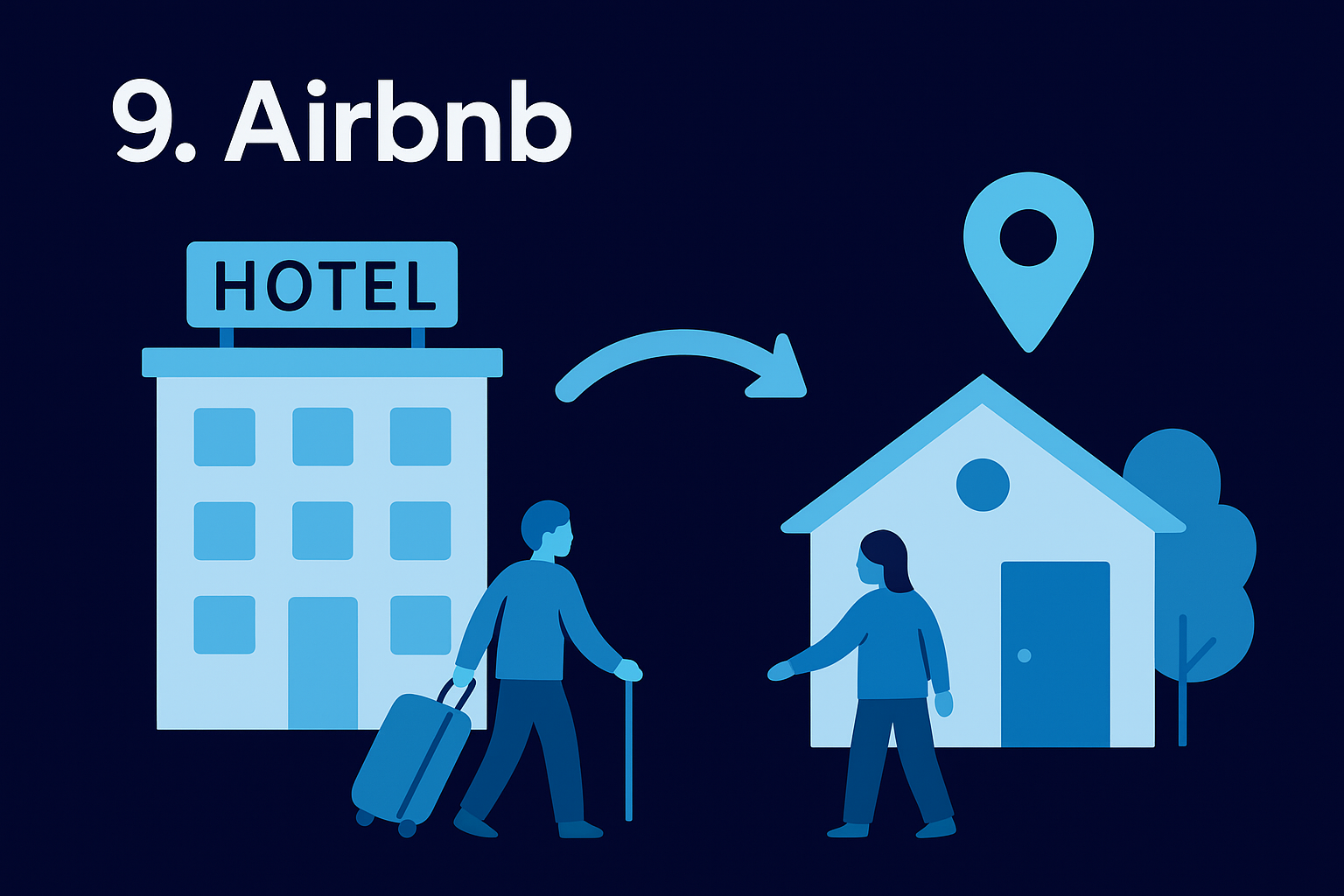
9. Airbnb
Airbnb entered the travel market against hotel chains with established loyalty programs, global footprints, and institutional trust built over decades. Rather than compete on those terms, Airbnb reframed what travel accommodation could mean by centering its entire identity on belonging, a concept no hotel chain had claimed or could credibly own.
The brand's positioning in one line
Airbnb is the travel marketplace for people who want to experience a destination like a local rather than a tourist passing through a branded lobby.
What Airbnb anchors that position on
Airbnb builds its position on human connection and community belonging rather than amenities or points programs. The brand's long-running tagline, "Belong Anywhere," communicates something no hotel can match: that staying in a real home, hosted by a real person, makes you part of a place instead of a visitor to it. That emotional distinction gives Airbnb a structural advantage hotels cannot replicate by adding more thread-count to their sheets.
When your positioning occupies emotional territory your competitors have never considered, you win a category that only your brand can define.
Where the positioning shows up in the real world
You see this in Airbnb's host storytelling, community-focused design, and experience offerings that extend well beyond accommodation. Every touchpoint reinforces the idea that travel is about people, not properties.
Template you can copy
"For [audience], [brand] is the [category] that [reframes the experience], because [human-centered differentiator]."
Airbnb's version: "For curious travelers, Airbnb is the travel marketplace that replaces tourist accommodation with genuine belonging, because real homes connect you to real places."
How to adapt it to your brand
When you study these brand positioning examples, notice that Airbnb never competed on price or amenities. Identify the deeper human need your category ignores entirely, then build your position around owning it.
10. Coca-Cola
Coca-Cola sells a product with hundreds of cheaper alternatives and at least one near-identical competitor in Pepsi. Despite that, Coca-Cola has maintained the most recognized brand position in the world for over a century by owning a single emotional territory: happiness and human connection. That consistency across generations and geographies is the result of a disciplined positioning decision, not luck.
The brand's positioning in one line
Coca-Cola is the iconic beverage brand for people who associate shared moments with simple, universal joy.
What Coca-Cola anchors that position on
Coca-Cola builds its position on emotional consistency and universal human experiences rather than taste profiles or ingredients. The brand has spent over 100 years connecting its product to moments people already value: holidays, celebrations, and everyday rituals. That association runs so deep that the brand itself becomes the memory trigger, not just the drink.
When a brand occupies the same emotional territory consistently enough, the product and the feeling become inseparable in the buyer's mind.
Where the positioning shows up in the real world
You see this position in Coca-Cola's holiday advertising, global sponsorships, and the iconic contour bottle that signals the brand before a single word appears. Every campaign points back to the same feeling regardless of the market or the decade.
Template you can copy
"For [audience], [brand] is the [category] that [emotional territory], because [proof of consistency]."
Coca-Cola's version: "For everyone, Coca-Cola is the iconic beverage brand that turns ordinary moments into shared ones, because it has anchored that feeling across every culture for over a century."
How to adapt it to your brand
When you study these brand positioning examples, notice that Coca-Cola never shifted its core emotional anchor even as products, campaigns, and markets changed around it. Pick one emotional territory your brand can credibly own, then defend it with the same consistency across every channel and every year.
Next Steps
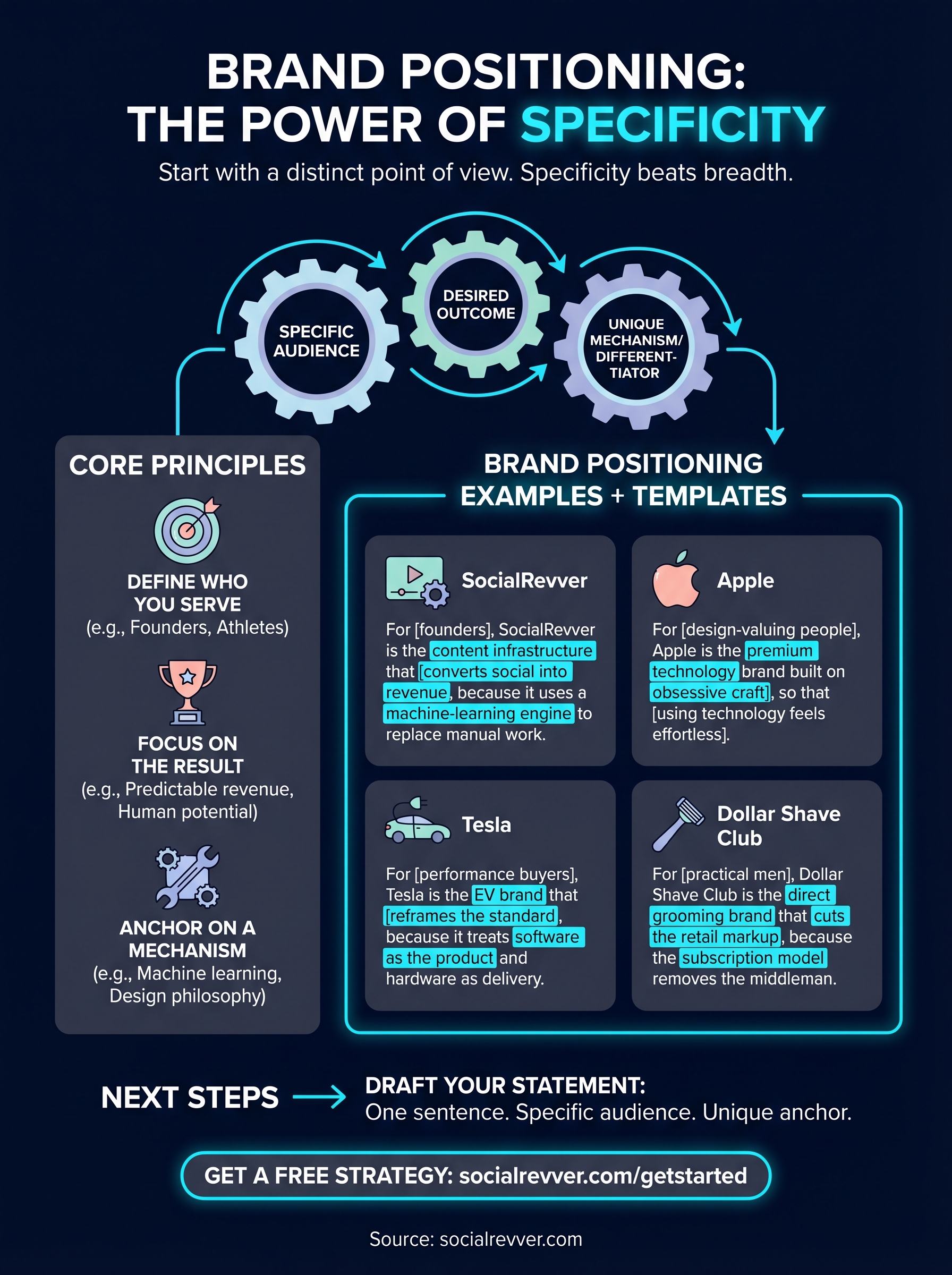
Every brand positioning example in this list points to the same underlying principle: specificity beats breadth every time. The brands that dominate their categories did not try to appeal to everyone. They made a clear decision about who they serve, what they stand for, and how they prove it across every touchpoint. That decision is available to your brand too, regardless of your industry or budget.
Start by writing a single positioning statement using one of the templates above. Keep it to one sentence, name your audience precisely, and anchor it on a mechanism only your brand can credibly own. Once you have that clarity, your content, your messaging, and your marketing all pull in the same direction. If you want a system that turns that position into predictable revenue through short-form content, apply to work with the SocialRevver team and get a free 40-slide social media strategy built around your brand.